Standard
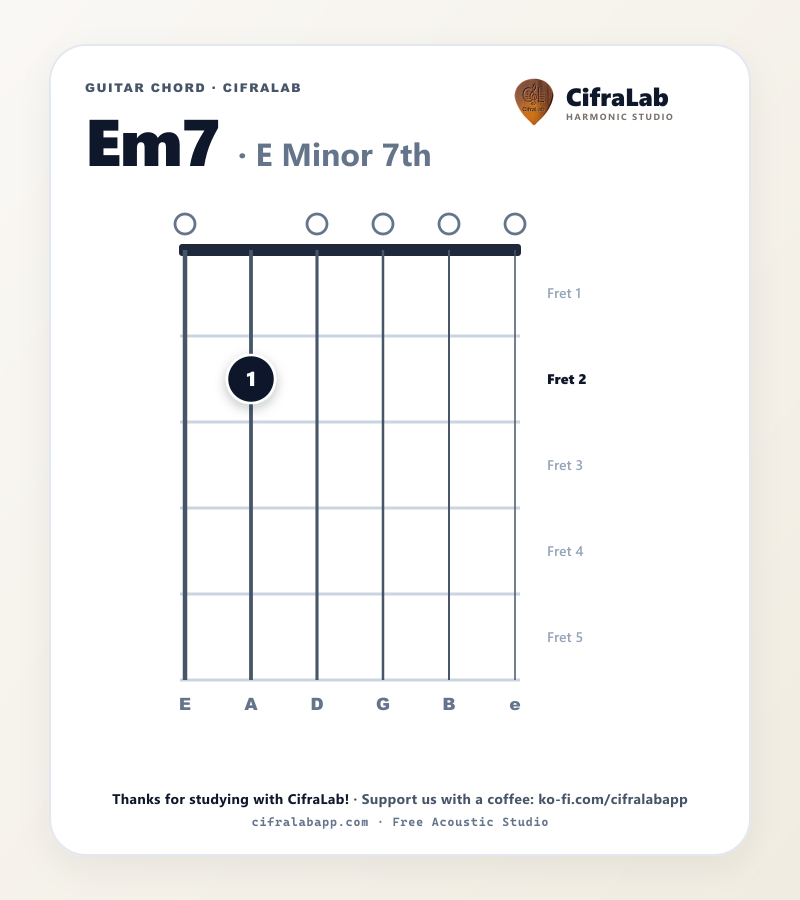
Standard PositionPlacement tip: Press: 5th String (A) at fret 2 with your Index finger. Play open: 6th String (Low E), 4th String (D), 3rd String (G), 2nd String (B), 1st String (High E).
Em7 guitar chord: see the fingering, compare positions, and hear it before you play.
P - m - i - m · Alternating Folk (4/4 · 4 notes · Level 1)
The 1st string repeats the E of the 6th. This pattern leaves it out. All 6 arpeggios
Alternating picking with steady pulse.
Play Em7 one string at a time and you hear E, G, B and D. E is the root, G the minor third, B the fifth and D the minor seventh.
From the low string to the high one you hear E, B, D, G, B and E. The root, E, shows up twice in the main shape. The lowest and highest notes are both E, two octaves apart, on strings 6 and 1.
Em7 lets five strings ring open. String 6 gives E, string 4 gives D, string 3 gives G, string 2 gives B and string 1 gives E. Every finger presses at fret 2. The second shape on this page starts at fret 2.
Em is one change away. String 4 is pressed at fret 2, bringing in E, the root of Em. Em7 holds the whole G chord inside it, G, B and D. The change that keeps the most fingers still is to G. One stays in place.
Em7 shows up in five keys. In G major it is the vi, in D major the ii and in C major the iii. The rest appear in the key list. Further down there are two songs that use it.
E 1G ♭3B 5D ♭7
Root Bass (Fundamental String)6th String (Low E) • Fret 0 (E)
String Control (Muted & Active)6 / 6 • Active and muted strings status indicator
Placement tip: Press: 5th String (A) at fret 2 with your Index finger. Play open: 6th String (Low E), 4th String (D), 3rd String (G), 2nd String (B), 1st String (High E).
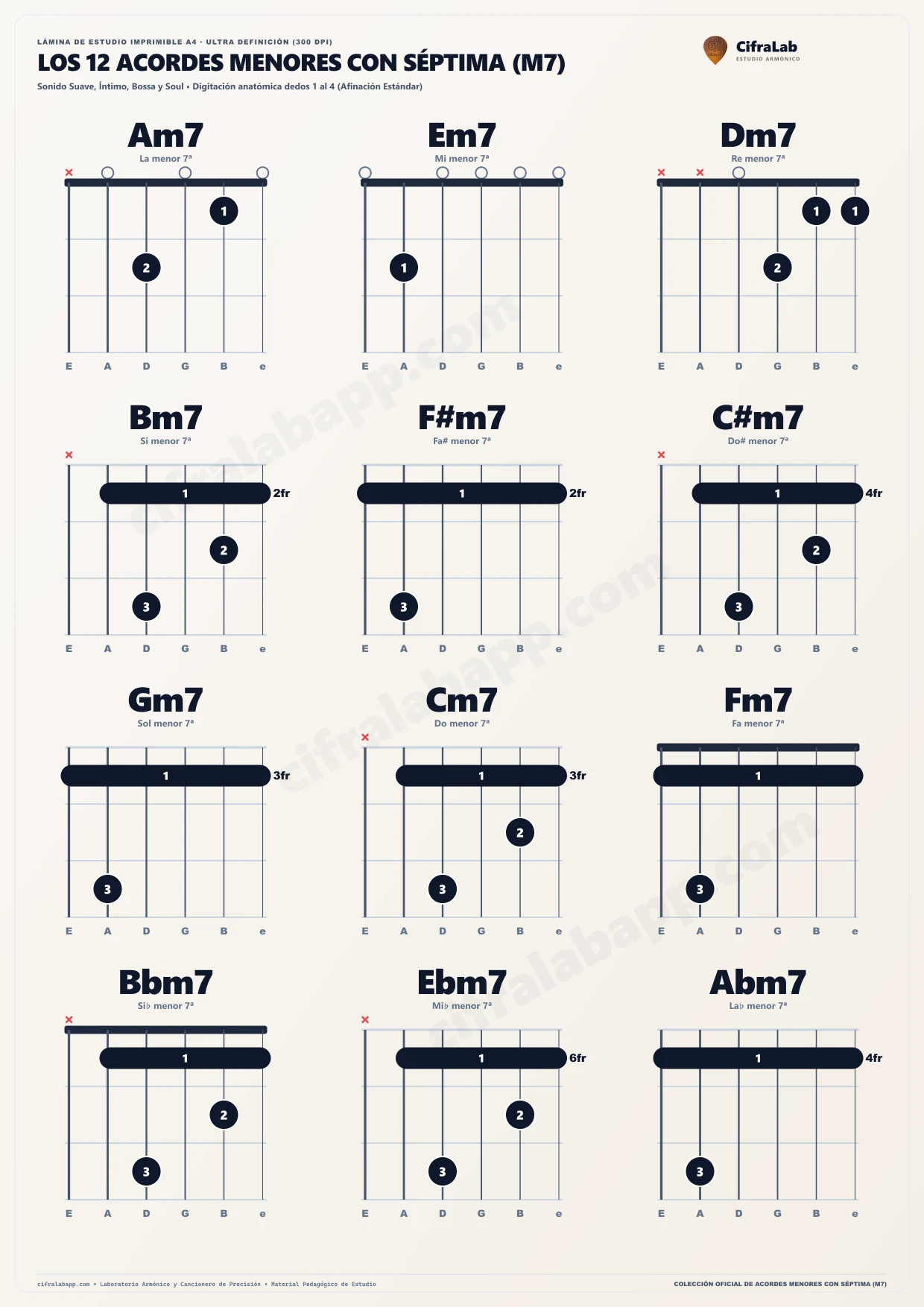
Placement tip: Press: 5th String (A) at fret 2 with your Index finger, 4th String (D) at fret 2 with your Middle finger, 2nd String (B) at fret 3 with your Pinky finger. Play open: 6th String (Low E), 3rd String (G), 1st String (High E).
| Item | In this chord |
|---|---|
| Frets | fret 2 |
| Fretting fingers | 1 |
| Open | 6th, 4th, 3rd, 2nd, and 1st |
| Muted | none |
The open 6th and 4th strings sit next to a fretting finger.
Listen: Em7 → Em · G · Bm
Em7 sits in the scale of 5 keys.
Well-known songs where this chord plays a clear role
The questions that come up most when playing this chord
To play the Em7 chord on guitar, all 6 strings are played from the 6th string (Low E) to the 1st string (High E). Arch your finger joints perpendicular to the fretboard so adjacent strings ring clearly.
The primary bass note of the Em7 chord is its root note: E. In standard guitar tuning (EADGBe), this bass note is located on string 6 at fret 0.
When strumming or fingerpicking, strike this string first.
The Em7 chord is constructed using the 1 - ♭3 - 5 - ♭7 formula (Minor Seventh). Its constituent pitches are E, G, B, D.
To prevent the Em7 chord from buzzing or sounding muted, press the strings using the tips of your fingers at a strict 90-degree hammer angle. Position each finger immediately behind the fret wire with your thumb centered behind the neck.
"Wish You Were Here" (Pink Floyd, 1975). Opens the intro (Em7 - G - Em7 - G - Em7 - A7sus4).
"Wonderwall" (Oasis, 1995). Opens the verse (Em7 - G - Dsus4 - A7sus4).
The best-known chart plays it with a capo on fret 2.

Thanks for studying with CifraLab
If this chord helped you, support us with a coffee on Ko-fi.