
How the Violin is Made and Why its Body Resonates
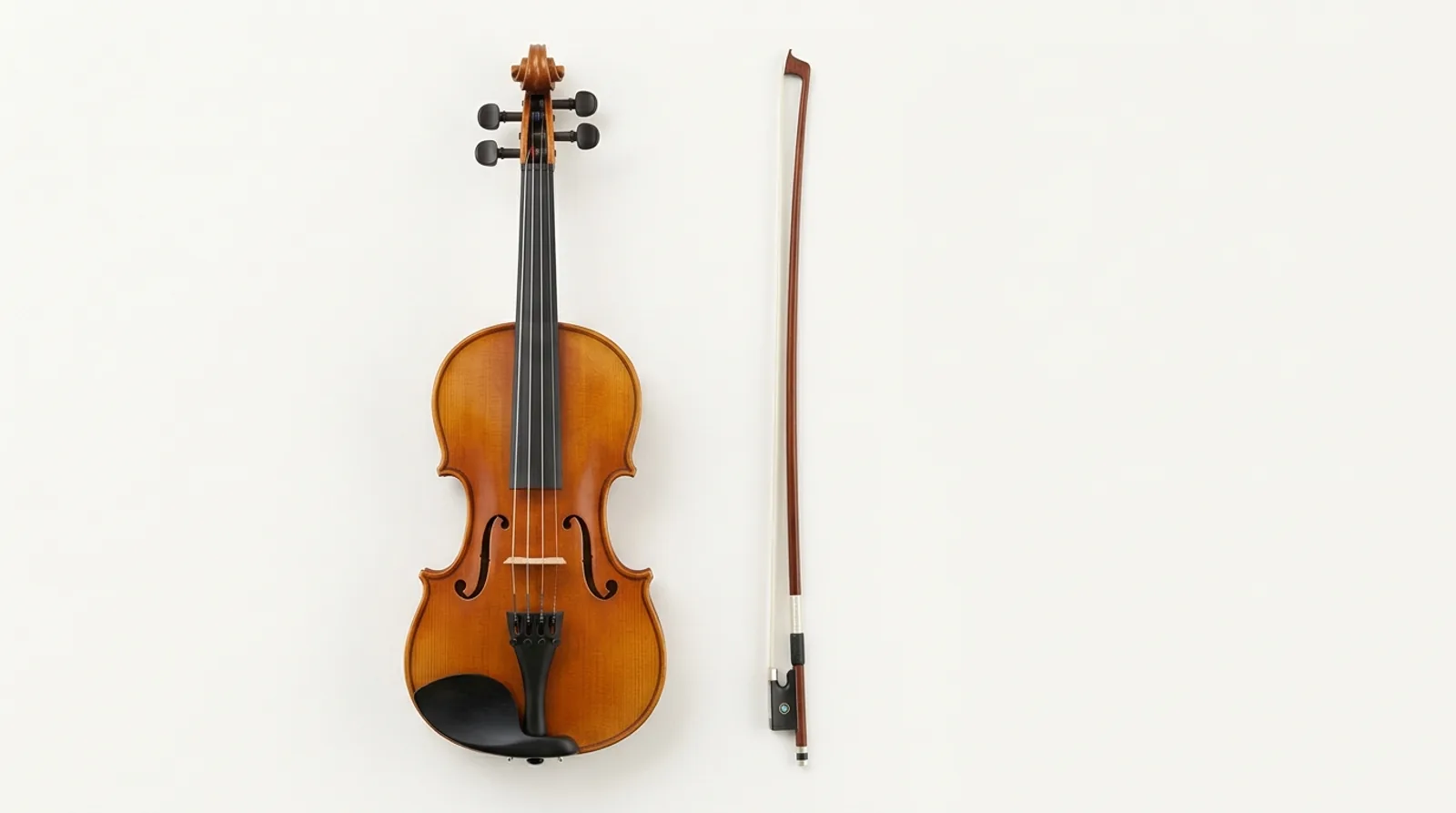
The violin is a hand-carved bowed string instrument.
Its European spruce soundboard measures between 2 and 4 millimeters thick.
The f-shaped openings allow air to breathe and the center of the top to vibrate freely.
The Bridge, Soundpost, and Bass Bar
The strings rest on the curved maple bridge.
- The bridge transforms the friction of the bow into vibrations in the wood.
- The cylindrical spruce soundpost transmits the sound from the top to the back.
- The bass bar is glued under the top to distribute the force of the lower strings.
The body generates a wide dynamic range with frequencies exceeding 8,000 Hz.
The violin produces a warm and bright sound without the need for amplification.
Tuning by Perfect Fifths and the Ear
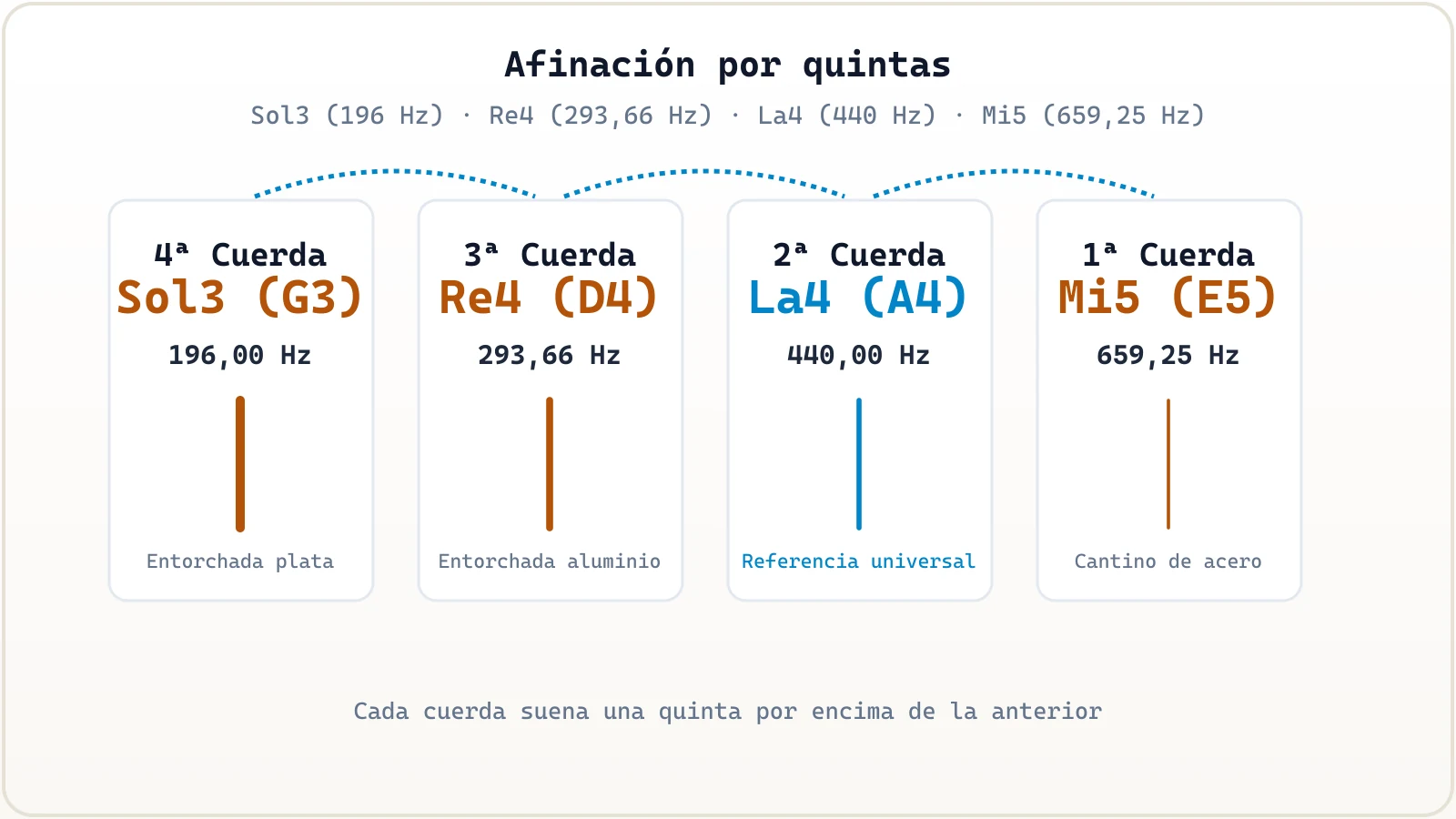
The violin is tuned in four strings by perfect fifth intervals.
You can hear each note on the violin homepage. In notation, they are written G3, D4, A4, and E5 from the fourth to the first string.
The Four Strings in Hertz
With the reference tuning fork at 440 Hz, the open strings vibrate as follows.
- Fourth string, G3, 196.00 Hz.
- Third string, D4, 293.66 Hz.
- Second string, A4, 440.00 Hz.
- First string, E5, 659.25 Hz, known as cantino.
The four strings exert more than 22 kilograms of combined tension on the top and about 10 to 11 kilograms on the bridge.
Unlike the piano, the violin is tuned by pure perfect fifths with a 3 to 2 ratio without acoustic beating.
Since it has no frets, you tune each note according to its melodic function.
How is the violin tuned between adjacent strings?
How to Read Note Diagrams on a Fretless Fingerboard
In CifraLab's violin charts, the four vertical lines are the G3, D4, A4, and E5 strings.
Since the fingerboard has no frets, the diagram shows where the fingertip rests.
What the Finger Numbers Indicate
- 0 is an open string.
- 1 is the index finger.
- 2 is the middle finger.
- 3 is the ring finger.
- 4 is the little finger.
The low and high labels indicate whether the finger moves closer to the nut or extends towards the bridge.
Each number represents the finger you place on the string.
How to Hold the Violin and Position the Chin Rest
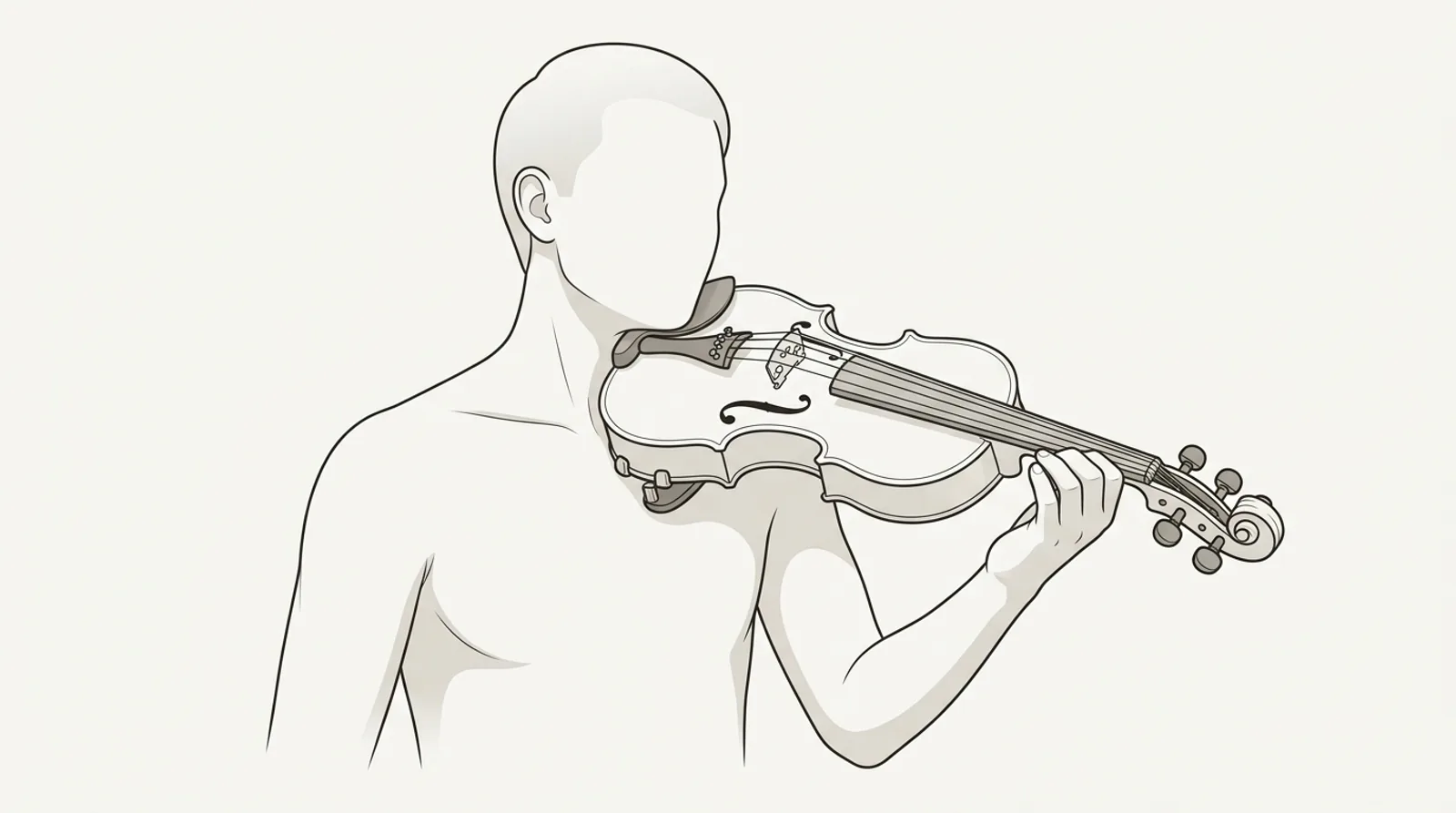
Try it on your violin
Rest the instrument on your collarbone with your jaw weight upon the chinrest. Confirm you can release your left hand completely without dropping the violin: holding it must never rely on hand grip.
Playing with ease requires your neck and shoulders to remain free of tension.
Support on the Collarbone
- Rest the violin on your left collarbone and shoulder.
- Use an adjustable shoulder rest to fill the gap between the instrument and your neck.
- Gently rest the weight of your jaw on the chin rest without clenching your teeth.
- Your left hand should not bear the weight of the instrument.
If you release your left hand, the violin should remain horizontally balanced.
Your left arm is free to slide your fingers along the fingerboard.
How to Hold the Bow and Move Your Right Arm
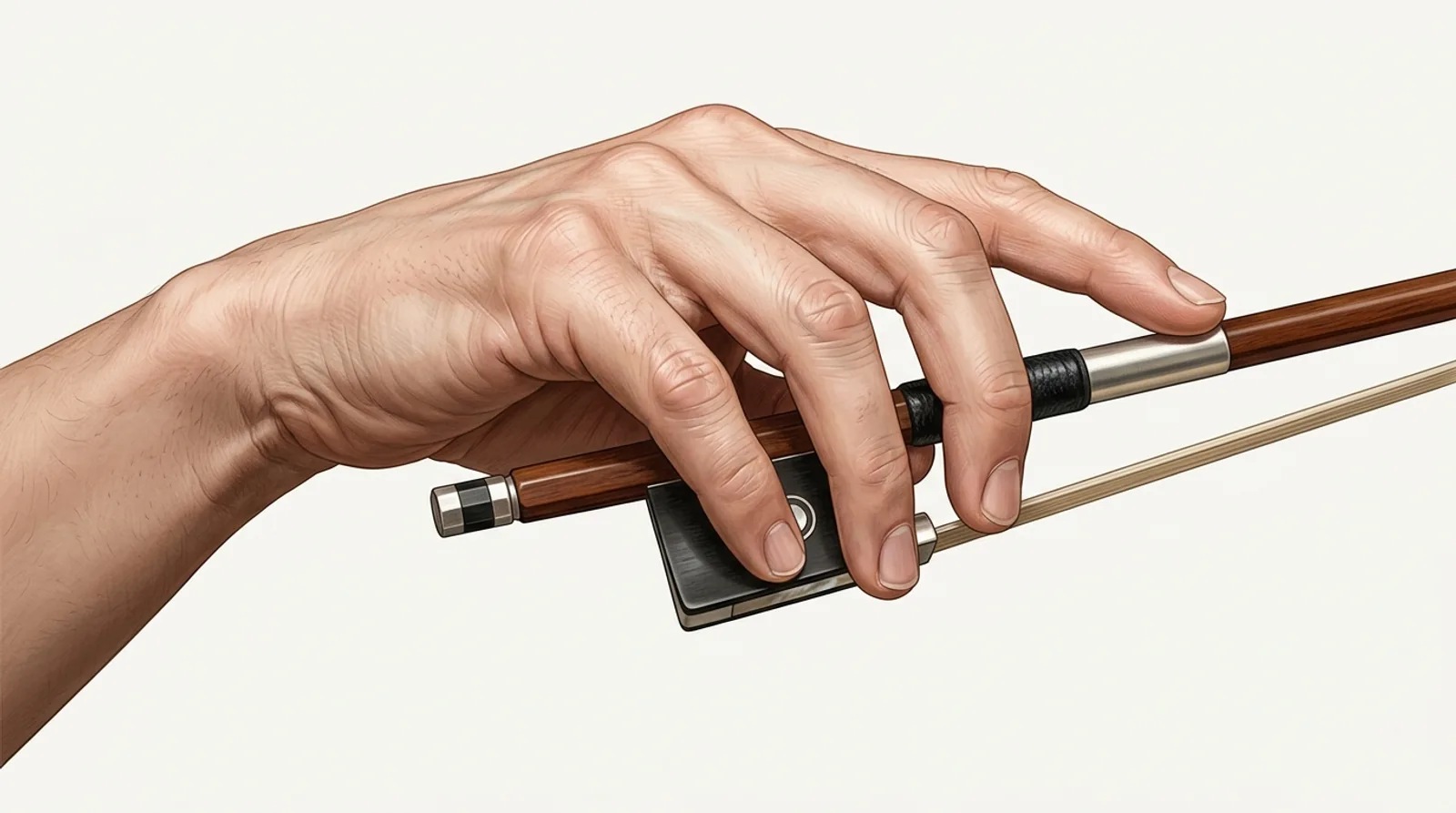
The bow is the violinist's voice and guides musical breathing.
The Right Hand Grip
- Rest your slightly curved right thumb at the base of the frog, opposite your middle finger.
- Place your index, middle, and ring fingers lightly on the stick.
- Rest your curved little finger on top of the wood to counterbalance.
- Keep your wrist flexible to cushion the down-bows and up-bows.
Curved fingers allow the bow to change direction smoothly.
The Physics of Sound: Contact Point, Speed, and Weight
The sound of the violin depends on three physical factors of the bow.
Contact Point, Speed, and Weight
- The contact point is the area of the string between the bridge and the fingerboard.
- Playing near the bridge gives a bright sound, and playing over the fingerboard gives a soft tone.
- For a full cantabile sound, keep the bow in the central strip.
- The speed and weight of the arm must be balanced to avoid harsh noises.
Moving the bow at a constant speed produces a full and continuous sound.
Fingers 1 and 2 in First Position: Tones and Semitones
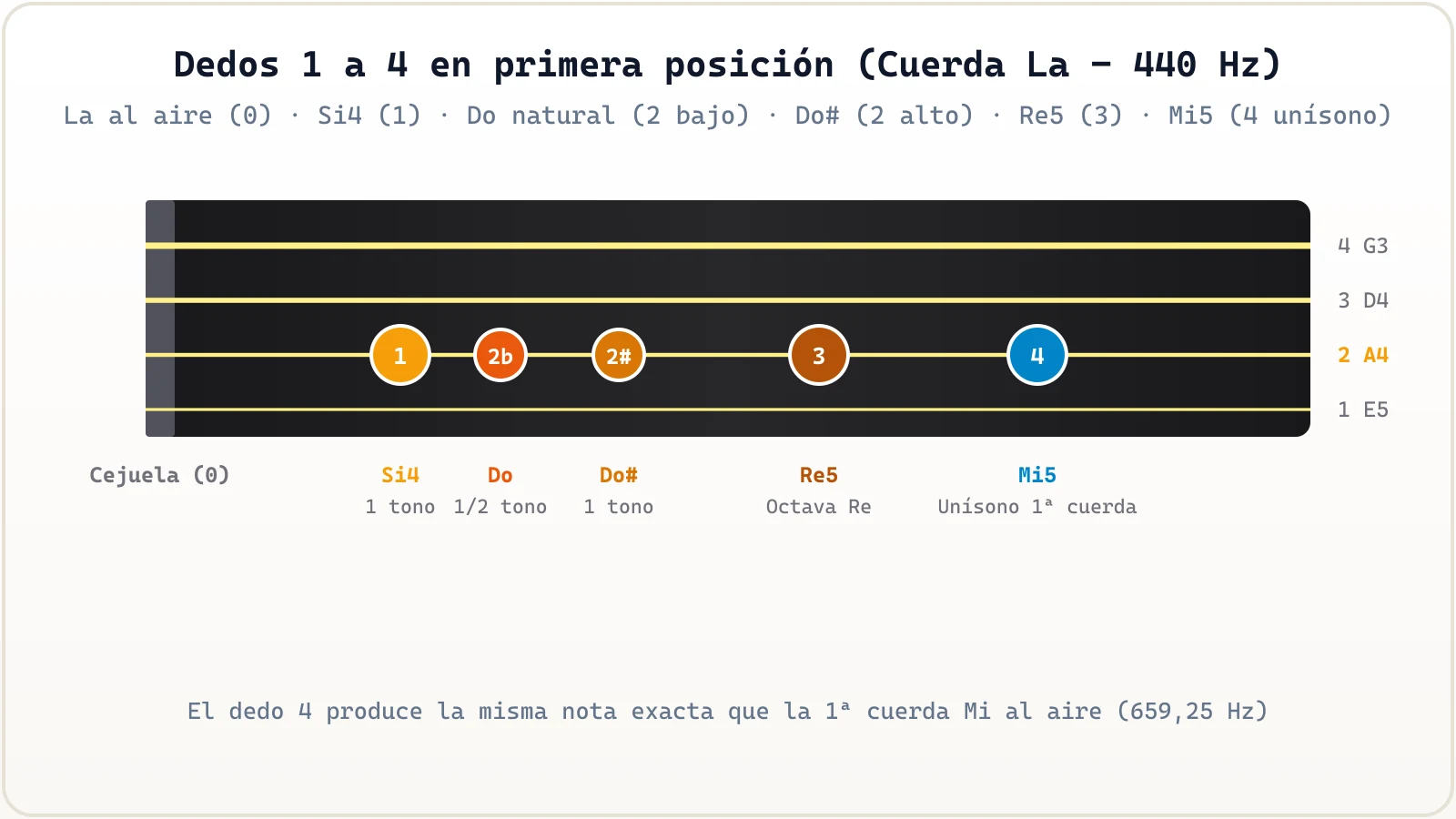
In first position, the hand is placed near the nut.
Tones and Semitones on the A String
On the A string at 440 Hz, finger 1 presses B4 at a whole step distance from the nut.
On the E5 string, the low finger 1 presses the natural F note, a half step from the nut.
Finger 2 can press close to finger 1 to produce natural C, forming a semitone, or separated to produce C sharp.
Feeling the friction between your fingertips is the best guide for placing your fingers correctly.
Two fingers together form a semitone, and two fingers separated form a whole tone.
The Third Finger and the Little Finger in Unison
The third finger presses a whole step from the second finger.
D5 and E5 on the A String
On the A string, finger 3 produces the note D5. It sounds pure when compared to the open D4 string an octave higher.
The little finger 4 presses a whole step higher and produces E5 at 659.25 Hz.
That E5 sounds exactly the same as the open E string.
Tuning the fourth finger in unison with the neighboring string gives you an infallible reference.
Chromatic Notes and Expressive Tuning
To play chromatic notes, the finger slides a few millimeters along the string.
Sliding the Finger Without Moving the Hand
To go from B flat to natural B on the A string, slide finger 1 towards the bridge without moving your palm.
A diatonic semitone is played with two different fingers, and a chromatic semitone is played by the same finger moving.
Hearing the note in your head before pressing tunes each semitone accurately.
Bow Strokes: Détaché, Legato, and Distribution
The bow produces different articulations depending on how you move it.
Détaché and Legato
- Détaché plays each note with a separate bow stroke, smooth and without abrupt cuts.
- Legato connects two or more notes within the same continuous bow stroke.
- Bow distribution manages the length of the stick so you don't run out of bow prematurely.
An elastic bow change connects the notes as if you were singing a melody.
Open Double Stops and Intervals
A double stop sounds when you bow two neighboring strings at once.
Open Fifths
The open pairs G-D, D-A, and A-E form pure perfect fifths.
Adjust the angle of your right arm so that the bow hair touches both strings with the same weight.
Then you can press B on the A string with open D to hear a consonant major sixth.
Playing double stops trains your ear to hear two voices at once.
Violin Care, Rosin, and Bow Hair
The violin requires daily care to preserve its sound.
Rosin and Cleaning
- Apply rosin to the horsehair bow every two or three sessions.
- Clean the strings and the top with a soft cloth after playing to remove white dust.
- Loosen the bow screw when finished so that the wood does not lose its natural curvature.
Caring for the wood and the bow keeps the instrument in perfect condition.
The Inner Ear and Sympathetic Resonance
Your inner ear is the primary guide for tuning.
Strings that Vibrate by Sympathy
When you play a well-tuned G, D, A, or E on any string, the corresponding open string vibrates on its own.
This acoustic resonance confirms that the note is perfectly in tune.
Record your lessons regularly to listen to your sound from an outside perspective and improve calmly.
Sympathetic resonance tells you when a note is perfectly in tune.
References for checking technique
Editorial text by CifraLab. These sources help check tuning, reading and technique. Diagrams are study guides and do not replace instrument setup or a posture assessment.