
How the Ukulele is Made and Why it Sounds That Way
The ukulele is a plucked string instrument. Its body has three parts: the top, the sides, and the back.
The body acts as a Helmholtz resonator. It's the same effect that makes a bottle sound when you blow across its mouth.
The Path of Sound
- You pluck the string and it vibrates.
- The vibration passes from the bone saddle to the wooden bridge.
- The bridge moves the top.
- The soundhole of the body projects the sound outward.
Frets and Size
The neck holds the fretboard. The metal frets divide it into semitones.
The distance between the nut and the saddle is called the scale. Each fret is placed using the 17.817 factor rule, ensuring each note is in tune.
There are soprano, concert, and tenor ukuleles. They differ in string tension and fret spacing.
If your ukulele sounds quiet, don't press harder. The volume depends on the body, not the force of your hand.
G, C, E, A Tuning and the Campanella Effect
Soprano, concert, and tenor ukuleles are almost always tuned to G4, C4, E4, and A4. You can hear them on the ukulele homepage. In chord notation, it's G4, C4, E4, and A4, from the fourth string to the first.
The fourth string has a surprise. Its G4 sounds higher pitched than the C4 and E4 that follow.
That's why the notes don't descend in order as you play across the strings. This is called reentrant tuning.
On the ukulele, the fourth string is not the lowest.
The Four Strings in Hertz
With A at 440 Hz as a reference and equal temperament, each string vibrates like this.
- Fourth string, G4, 392.00 Hz.
- Third string, C4, 261.63 Hz.
- Second string, E4, 329.63 Hz.
- First string, A4, 440.00 Hz.
The lowest note is C4. G4 is a perfect fifth above it.
When strumming down, you pass through a high note, G4. Then you go down to the lowest, C4, and back up to E4 and A4.
If You Prefer a Low G String
Some people replace the fourth string with a thicker one tuned to G3, at 196.00 Hz. This is called low G.
You gain lower notes for playing solos, but the chords change color. At CifraLab, we always use the high G4.
The Campanella Effect
Play a melody by distributing each note on a different string, instead of moving along a single one.
Let each note ring while the next one sounds. The notes blend like in a carillon or a small harp.
This sound is called campanella. It's easy to achieve with open chords because open strings have many harmonics.
Since the notes are so close together, this sound is also called close harmony.
What is the defining trait of standard re-entrant ukulele tuning?
How to Read a Chord Diagram
A diagram is a picture of the fretboard viewed from the front, with the ukulele standing upright.
- The four vertical lines are the G, C, E, and A strings, from left to right.
- The horizontal lines are the frets.
- The thick line at the top is the nut.
- If the chord is higher up the fretboard, a number next to it indicates the fret where it starts.
Fingers, Circles, and X's
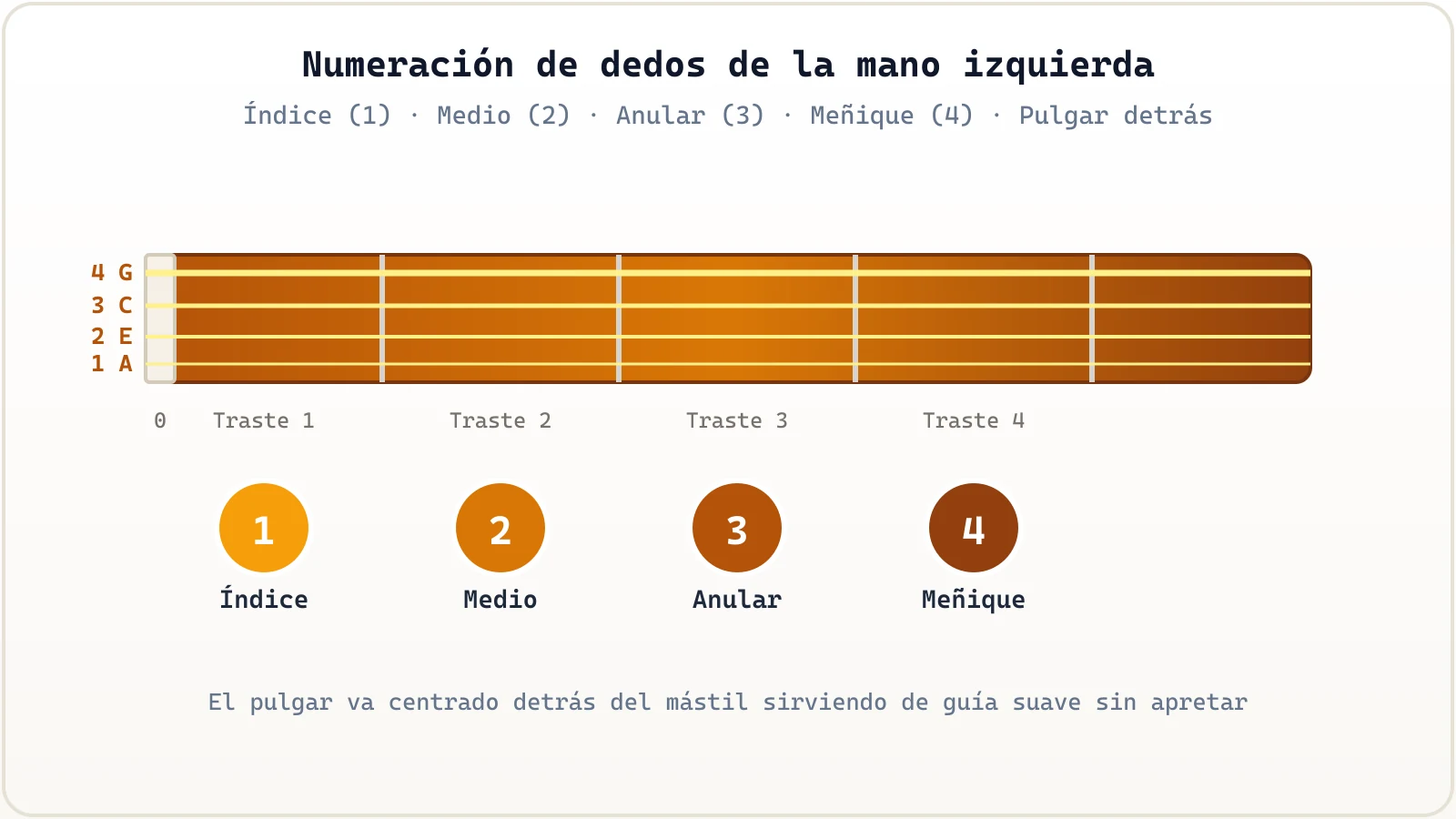
The dots show where each finger goes. The number inside the dot indicates which finger to use.
- 1 is the index finger.
- 2 is the middle finger.
- 3 is the ring finger.
- 4 is the little finger.
A circle at the top marks an open string, which sounds without being fretted. An X marks a string that should not sound.
You will also see four numbers, like 0003. They are read from the fourth string to the first. Each number is the fret you press, and 0 is an open string.
C major is 0003. Three open strings and the first string at fret 3.
Practice reading with the 60 chord charts, which include their diagram and sound.
How to Hold the Ukulele and Position Your Fingers
Try it on your ukulele
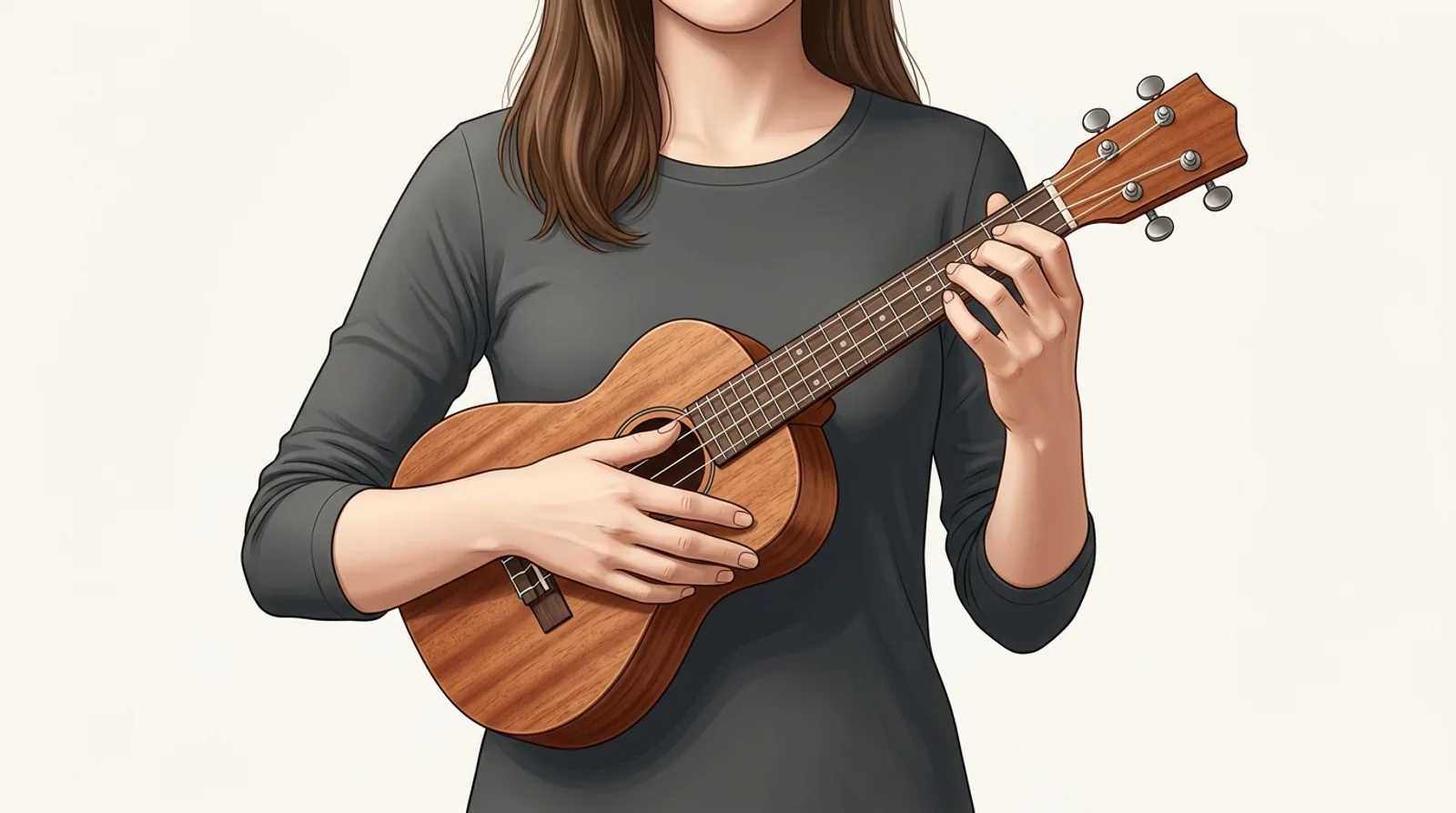
Rest your left thumb flat behind the second fret on the back of the neck. This neutral wrist angle avoids fatigue and lets your fingertips attack all four strings perpendicularly.
Holding it Without Squeezing
- Hug the lower part of the body with your right forearm.
- Rest it gently against the upper part of your abdomen.
- Don't press it against your chest. If you press the top or back, the wood vibrates less and the ukulele sounds quieter.
- Tilt the neck upward, between 25 and 40 degrees. Never parallel to the floor or downward.
With the neck tilted, your left wrist remains straight and doesn't bend too much.
The Fingers
Curve your fingers as if holding a small ball. Each joint should be bent and relaxed.
Press with the fingertip, firmly but without pressing too hard. Place your finger just behind the fret, never on top of it.
Close to the fret, you need much less force and the note sounds clean, without buzzing.
The Thumb and Wrist
The thumb rests flat behind the neck, at the height of the second fret. It's a support, not a clamp.
If your thumb sticks out over the top, your wrist cannot rotate. Your fingers will be flat and mute the adjacent strings.
Keep your wrist straight and your shoulders relaxed. This helps prevent tendon pain.
Your First Four Chords and How to Switch Between Them
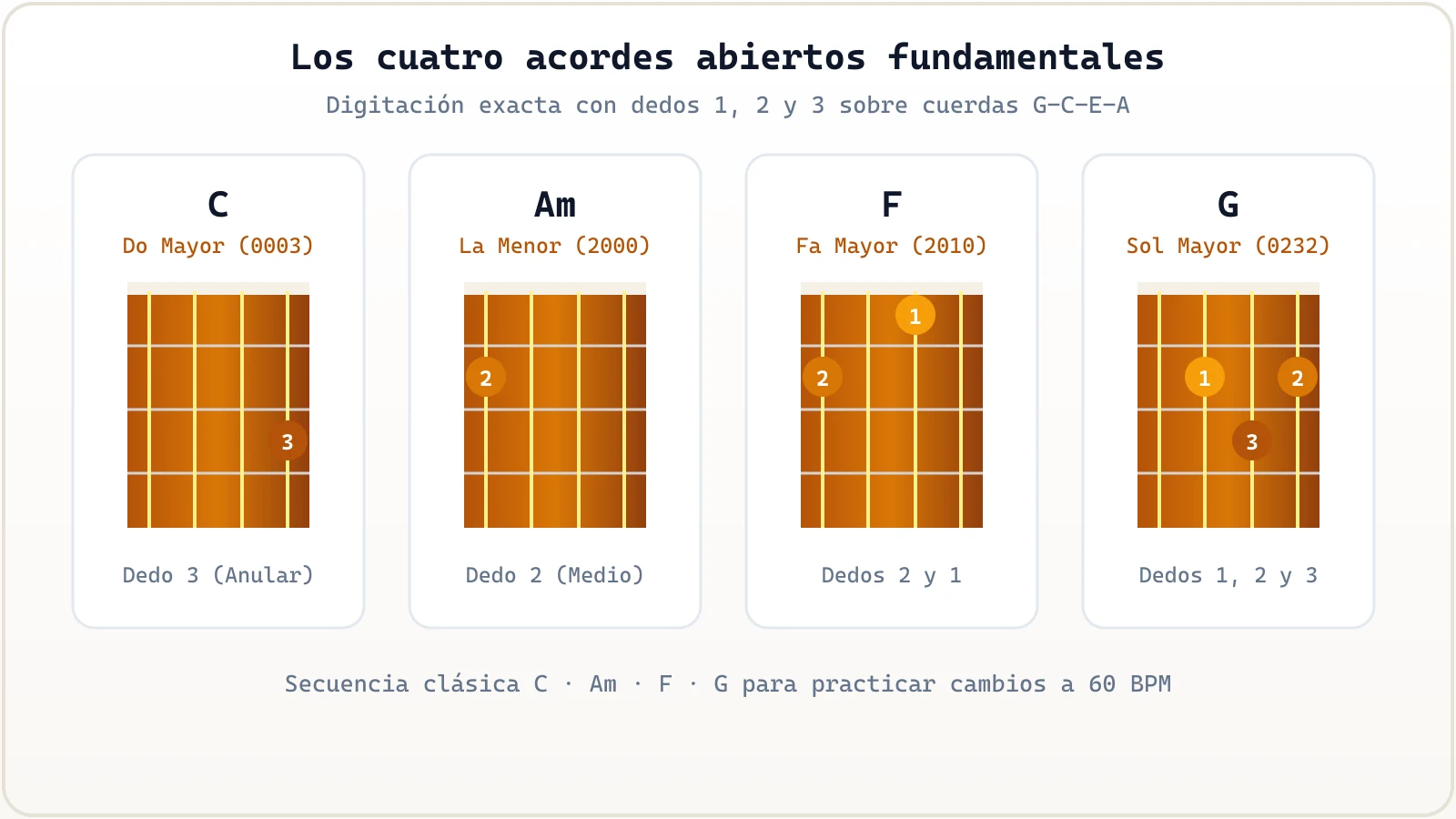
With four chords, you can already play many songs. Each has its own chart with sound, like C, Am, F, and G.
- C major, C, is written 0003.
- A minor, Am, is written 2000.
- F major, F, is written 2010.
- G major, G, is written 0232.
In C major, your ring finger presses fret 3 of the first string. The other three strings sound open.
In A minor, your middle finger presses fret 2 of the fourth string.
G major uses three fingers at once.
- The index finger, on fret 2 of the C string.
- The ring finger, on fret 3 of the E string.
- The middle finger, on fret 2 of the A string.
What Role Each Chord Plays
In the key of C major, each of these chords has a role. C is the tonic, the I degree. Am is the relative minor, the vi.
F is the subdominant, the IV. G is the dominant, the V, which calls for a return to C.
Before strumming, play each chord string by string. If one sounds muffled or buzzes, curve your finger more before pressing.
Changing Without Lifting Your Hand
The trick is to move your fingers as little as possible. If a finger works for both chords, leave it in place. That finger is your anchor.
From Am to F, the middle finger stays in place. Only the index finger moves down to fret 1 of the second string.
To go to G, move your fingers together, as a block, without opening your hand too wide.
Major and Minor Chords
A basic chord has three notes. They are called the tonic, third, and fifth, and together they form a triad.
The Major Chord
In a major chord, the third is 4 semitones from the tonic and the fifth is 7. It sounds bright and stable.
C major has C, E, and G. On the ukulele, 0003 gives G4, C4, E4, and C5. The C appears twice thanks to the reentrant tuning.
The Minor Chord
The minor chord lowers the third by a half step. It is 3 semitones from the tonic, and the fifth does not change.
That half step changes the character. The chord sounds more intimate or nostalgic.
A minor, 2000, gives A4, C4, E4, and A4. All are notes of the chord.
Major or minor depends on a single note, the third.
Seventh Chords, the Chord with One More Note
A seventh chord is a normal chord with one more note.
The Dominant Seventh
Take G, which has G, B, and D. Add F and you have G7, which on the ukulele is 0212.
That F is 10 semitones from G. With B, it forms a tritone, an interval that sounds restless.
That's why G7 leaves the music in suspense and the ear wants to move to C major. G7 almost always comes before C.
Major Seventh and Minor Seventh
Cmaj7 adds a major seventh, 11 semitones away. On the ukulele, it's 0002 and sounds serene, as in bossa nova and jazz.
Am7, which is 0000, and Dm7, which is 2213, are minor chords with a seventh. They sound sad but gentle.
They work very well as passing chords in the ii - V - I progression. You can hear it in the harmonic circles.
Barre Without Pain
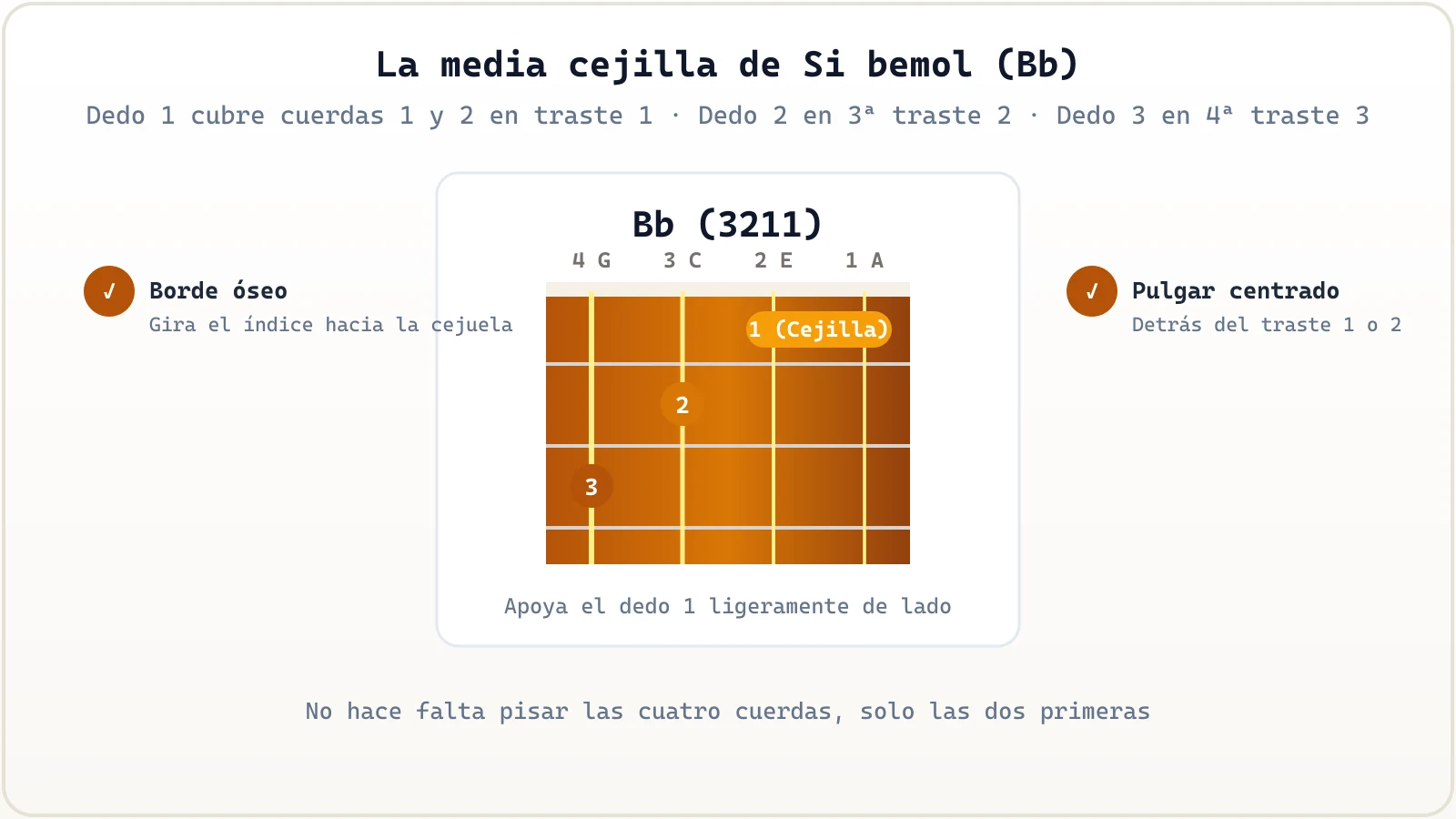
To play a barre, you press several strings on the same fret with your index finger stretched out. The index finger acts as a nut.
In B flat major, Bb, which is 3211, the index finger presses the first and second strings on fret 1. Fingers 2 and 3 complete the shape. This is a half barre.
How to Make it Not Hurt
- Don't press with the soft part of your finger.
- Rotate your index finger slightly outward and rest on the side, where the bone is firm.
- Place your finger very close to the fret.
- Let your arm's weight do the work, without pinching the neck between your thumb and index finger.
Barre chords are achieved with weight and good position, not with force.
The Notes of the First Four Frets
The first four frets contain the notes you need for your first melodies.
Look at the third string, the C4 string. This is how the notes ascend fret by fret.
- Fret 1, C sharp or D flat, C#4 or Db4.
- Fret 2, D4.
- Fret 3, E flat, Eb4.
- Fret 4, E4.
One Finger Per Fret
Play this chromatic scale to loosen up all four fingers. Each finger has its fret. Finger 1 goes to fret 1, 2 to fret 2, 3 to 3, and 4 to 4.
Go up and down slowly. Don't lift a finger until you need it. This keeps your hand compact and minimizes movement.
The Right Hand, Strumming and Arpeggio
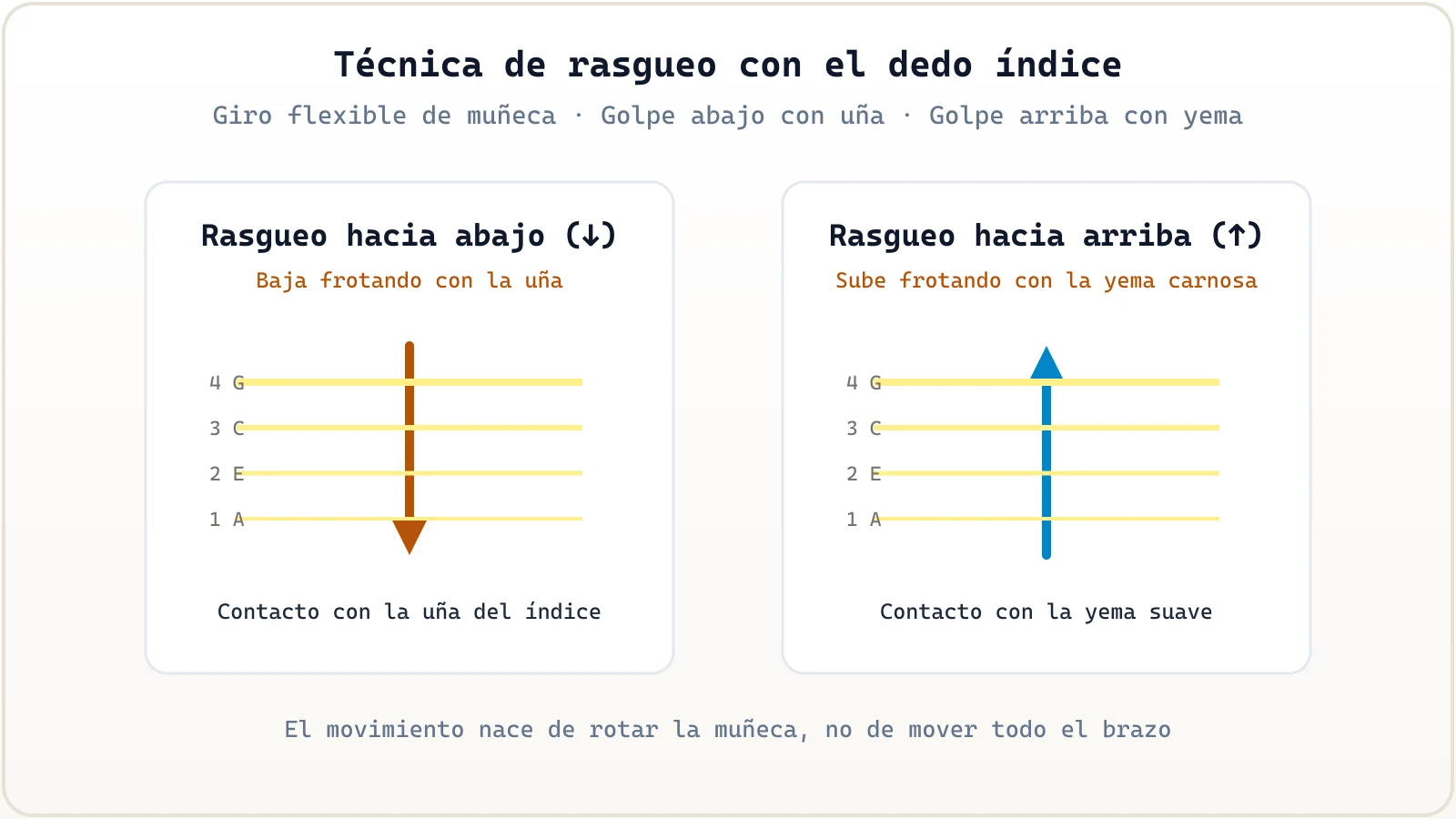
The right hand makes the ukulele sound in two ways. It can strum all the strings or pluck them one by one.
Basic Strumming
The movement comes from the forearm and wrist, which rotate loosely.
When strumming down, the back of your index finger's nail brushes the strings. When strumming up, the fingertip of the same finger gently touches them back. Try the patterns in ukulele strumming.
The Arpeggio
For arpeggiating, each finger has its string. The same idea is used in guitar, and we explain it in the arpeggio reading.
- The thumb, p, plays the fourth string, G, and the third, C.
- The index finger, i, plays the second, E.
- The middle finger, m, plays the first string, A.
Press with an elastic attack. The sound will be round if you don't pull the string outwards.
Muting the strings to mark the rhythm
Music is made of sound and silence. If you control how long each chord lasts, the rhythm will sound clear.
To mute the strings, rest the side of your right hand on them right after strumming. The sound will cut off abruptly. This technique is called muting.
Muting with the left hand
For fretted chords, you can also loosen your fingers without lifting them from the strings. The sound will mute the same way.
Try alternating sounding strums with muted strums. This is how the rhythm of reggae, calypso, and ska is born.
If it sounds bad, look here for the cause
The note buzzes
This is almost always due to finger position. It's too far from the fret or pressing right on top of the metal.
Move your finger closer to the fret and try again before pressing harder.
The string sounds muffled
Most likely, a neighboring finger is lying flat and touching that string. Curve your fingers so they press with the tips.
It buzzes even if you play correctly
Then it might be the instrument. The strings could be worn out or the saddle poorly adjusted. Humidity also affects the wood.
How to practice to improve every day
Set a small, specific goal for each session.
Use the metronome. Start slow, at a speed where you notice every movement without tension.
Only increase the speed when you can play the passage five times in a row without errors and without tension.
Record yourself
Record short sections with your phone. Listen to them afterward, without the ukulele in your hands.
This way, you hear what you miss while playing. For example, if you sped up during a chord change, if the first string sounded clear, or if the silences were clean.
Listening to your recordings teaches you to correct yourself and helps you progress faster.
References for checking technique
Editorial text by CifraLab. These sources help check tuning, reading and technique. Diagrams are study guides and do not replace instrument setup or a posture assessment.