
Free harmony studio
Chords, progressions and theory for guitar, piano, ukulele, bass and violin
CifraLab helps you learn and look up music. Each chord comes with its finger position and actual sound. There are ready-to-practice progressions and readings that explain why they sound the way they do.
Chord symbols
- C
- Am
- F
- G
Staff
Tablature
Written for the story behind CifraLab.
- Am
- F
- Dm
- E
Guitar tablature
Ukulele tablature (G-C-E-A)
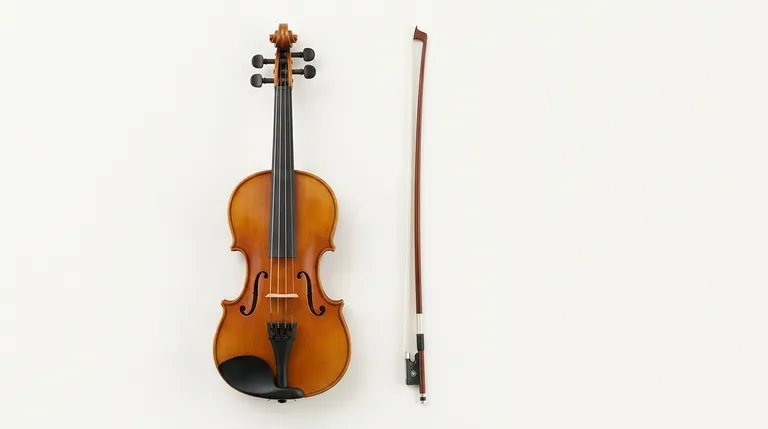
Violin: string and finger in first position
- A2
- E0
- E3
- E2
- E3
- E1
- A2
- A0
- A3
- E1
- E3
- E1
- E0
- E0
- D3
- A1
- A0
Piano keys
Bass
What do you want to do today?
Learn from scratch
Courses by level that start with posture and your first chords.
Look up a chord
Diagram, notes, variations and sound for every chord.
Practice & Agility
Looping progressions, fast chord switching, barre technique and ear training.
Understand music
Readings on harmony, history, fretboard scales and technique, with sources.
Choose your instrument
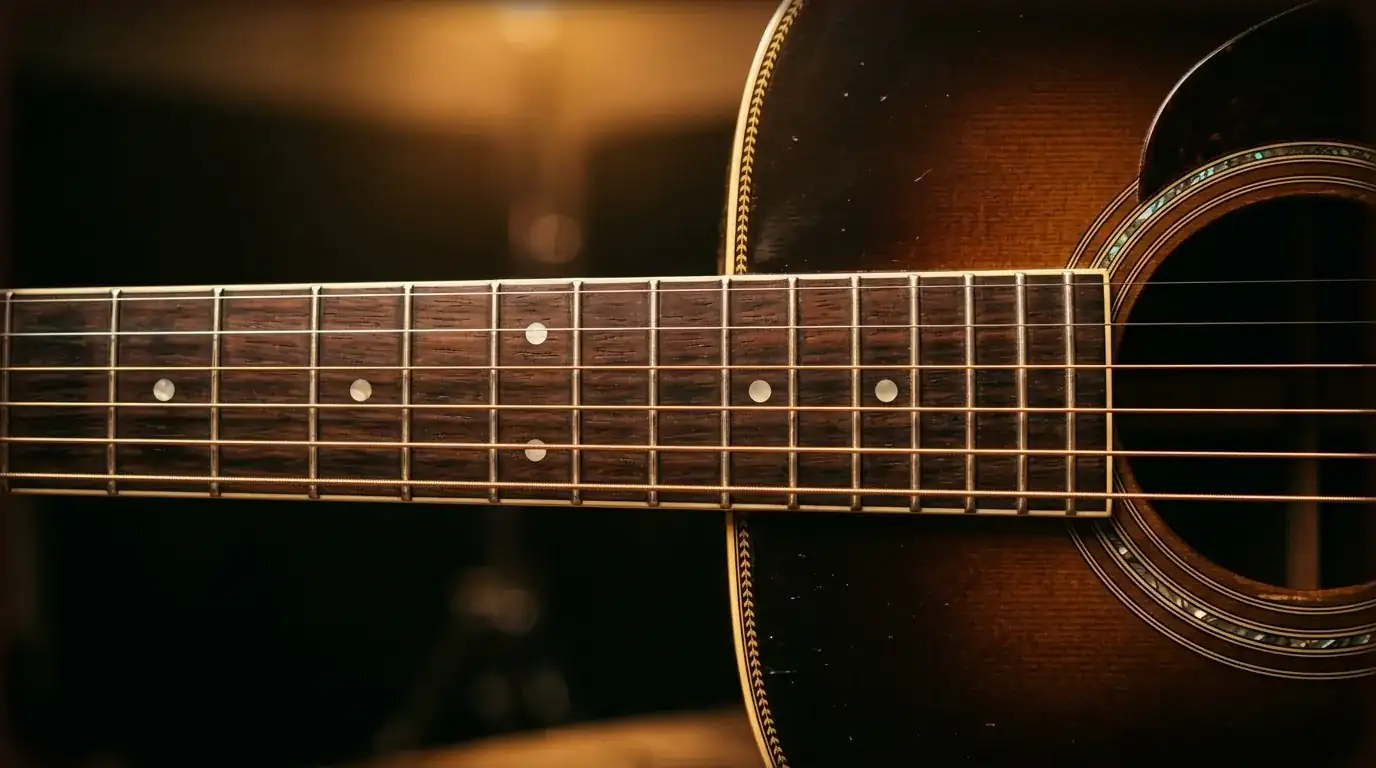
Guitar
223 · 24 · 121223 chords with finger positions and barre shapes, 24 chord circles, 121 strumming patterns, arpeggios, a fretboard and a step-by-step course.
Go to guitar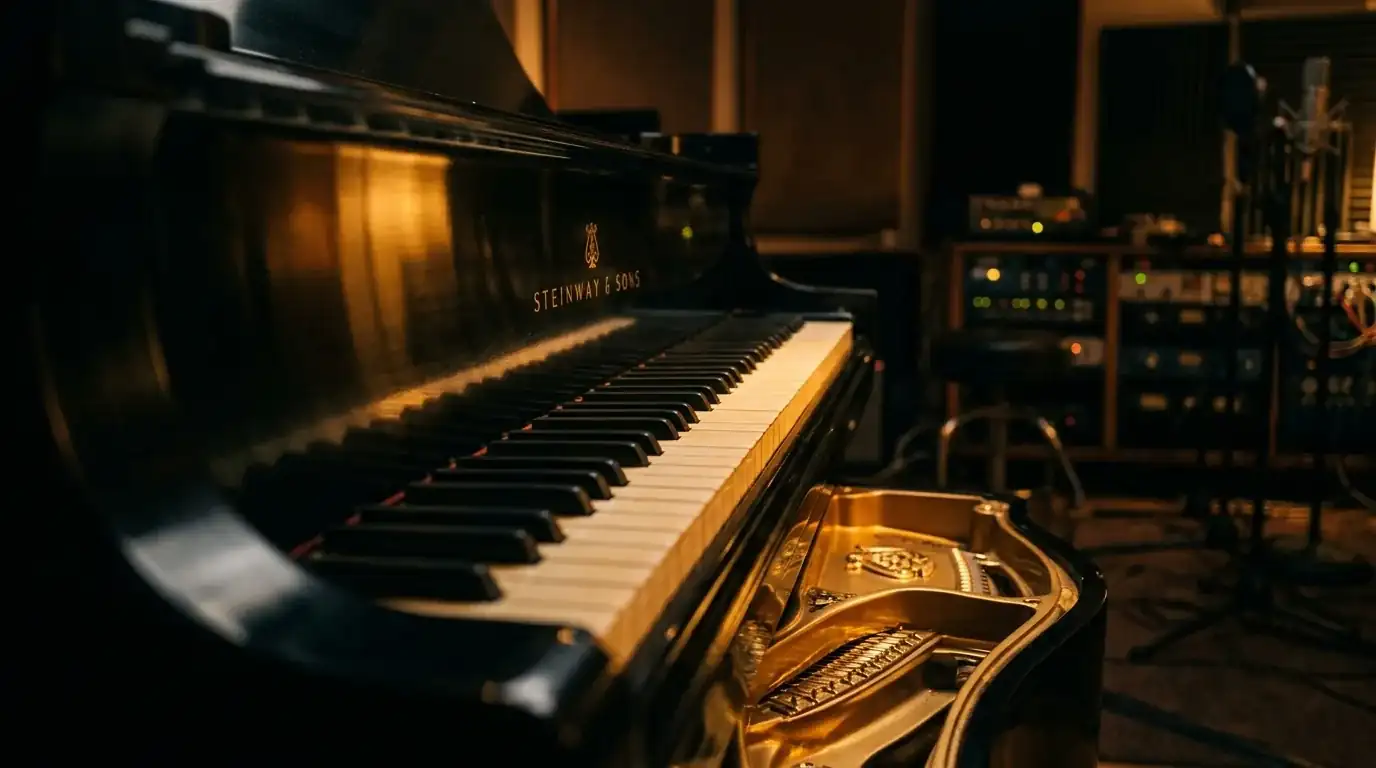
Piano and keyboard
69 · 8869 chords on the keyboard with fingers 1 to 5, chord circles, arpeggios, accompaniments and an 88-key virtual piano.
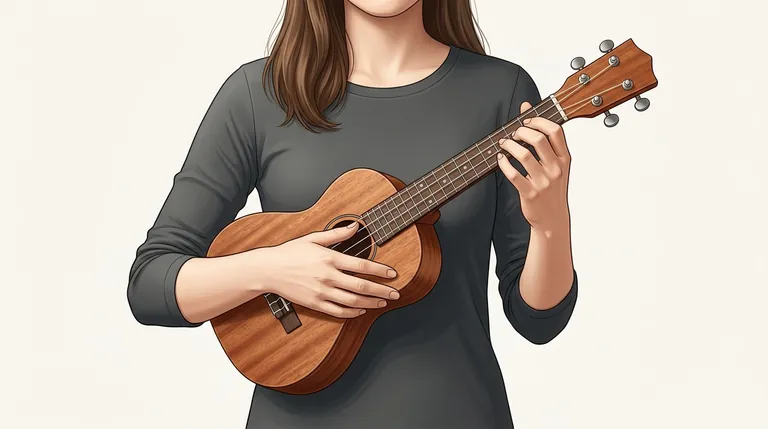
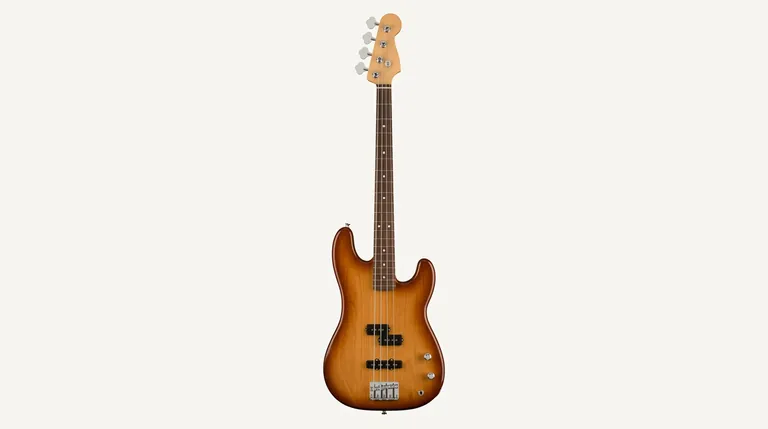
Go to pianoAlso ukulele, bass and violin
Learn step by step
Two free courses that start from zero. Every lesson has a practice with sound, and your progress is saved in this browser.
Guitar course
From your first chord to Latin American rhythms, with drills for fast chord changes.
First lessons
- Posture, tuning, and hand care
- Strings, Frets, and Your First TAB
- Your first two chords: Em and Am
Piano course
From posture and middle C to ballads, bolero and reading sheet music.
First lessons
- Prepare the Body
- Find Middle C
- Build C Major
Most searched chords
These twelve cover a large part of popular songs. Each page shows the fingering finger by finger and the sound of every string.
See all 223 chordsStrumming and rhythm
121 strumming patterns with metronome and real sound. There's pop, rock, folk, and Latin American rhythms like pasillo, cumbia, or zamba. Each arrow represents a downstroke or upstroke of the right hand.
- 4/4 · 70 BPM··
- Ecuadorian Pasillo3/4 · 90 BPMBBBB·
- Colombian Cumbia2/4 · 96 BPMx·x·
downupBbassxmuted stroke·rest
Piano and keyboard
The same chords, viewed on the keyboard. You see which notes form each one, which fingers from 1 to 5 play them, and how to distribute them between both hands. The left hand plays the bass. The illustration shows C major, with C, E, and G played by fingers 1, 3, and 5.
Printable charts
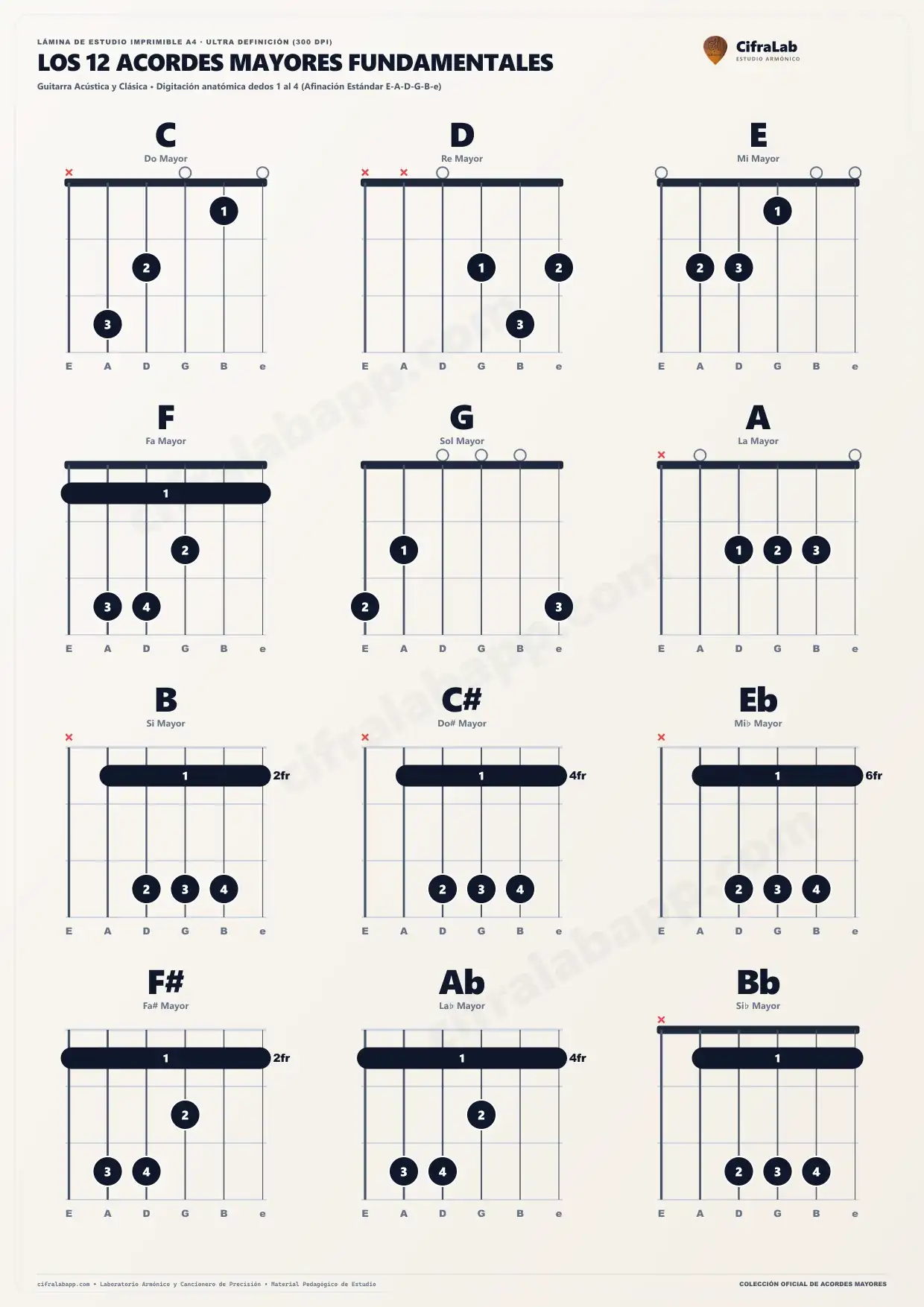
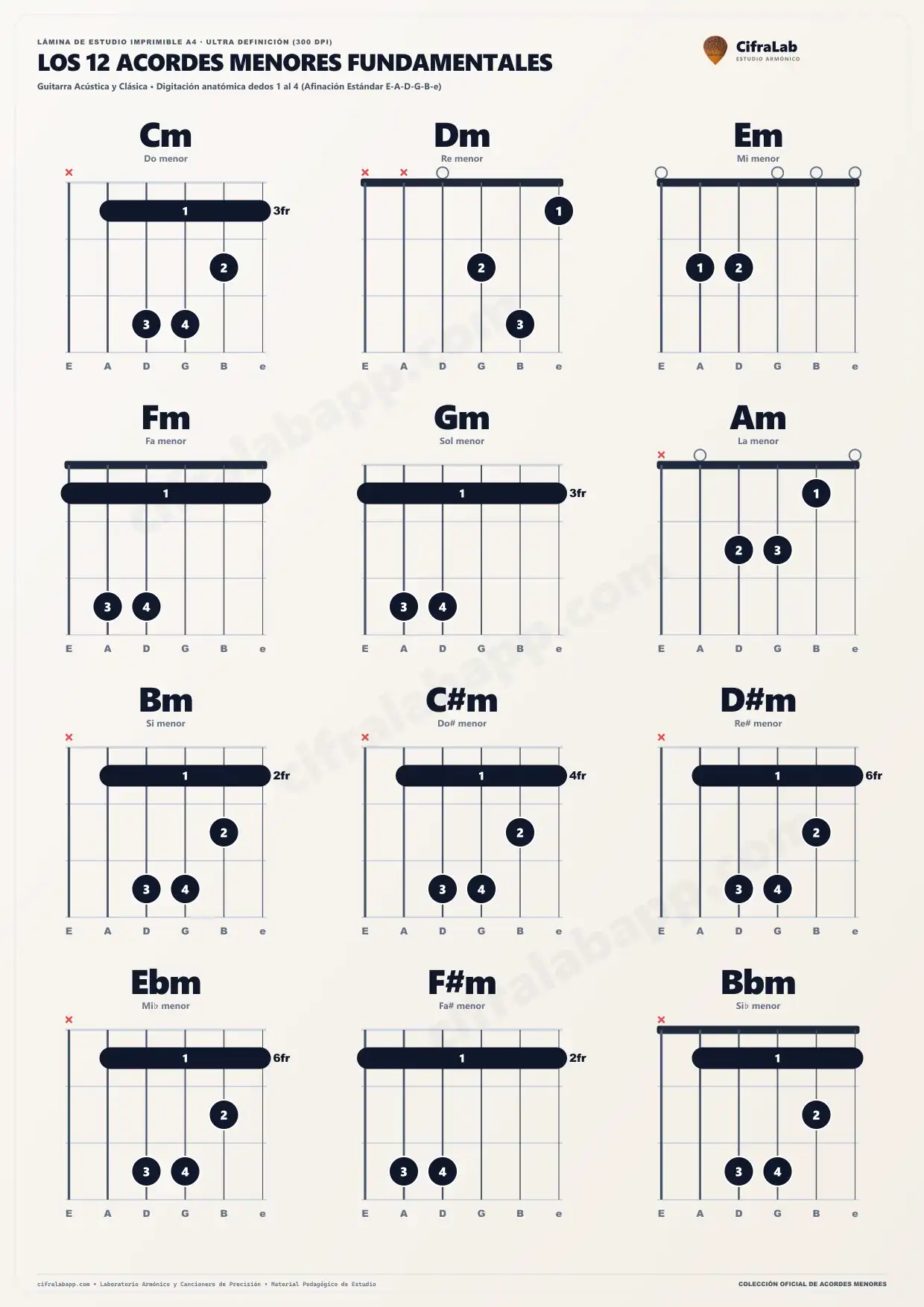
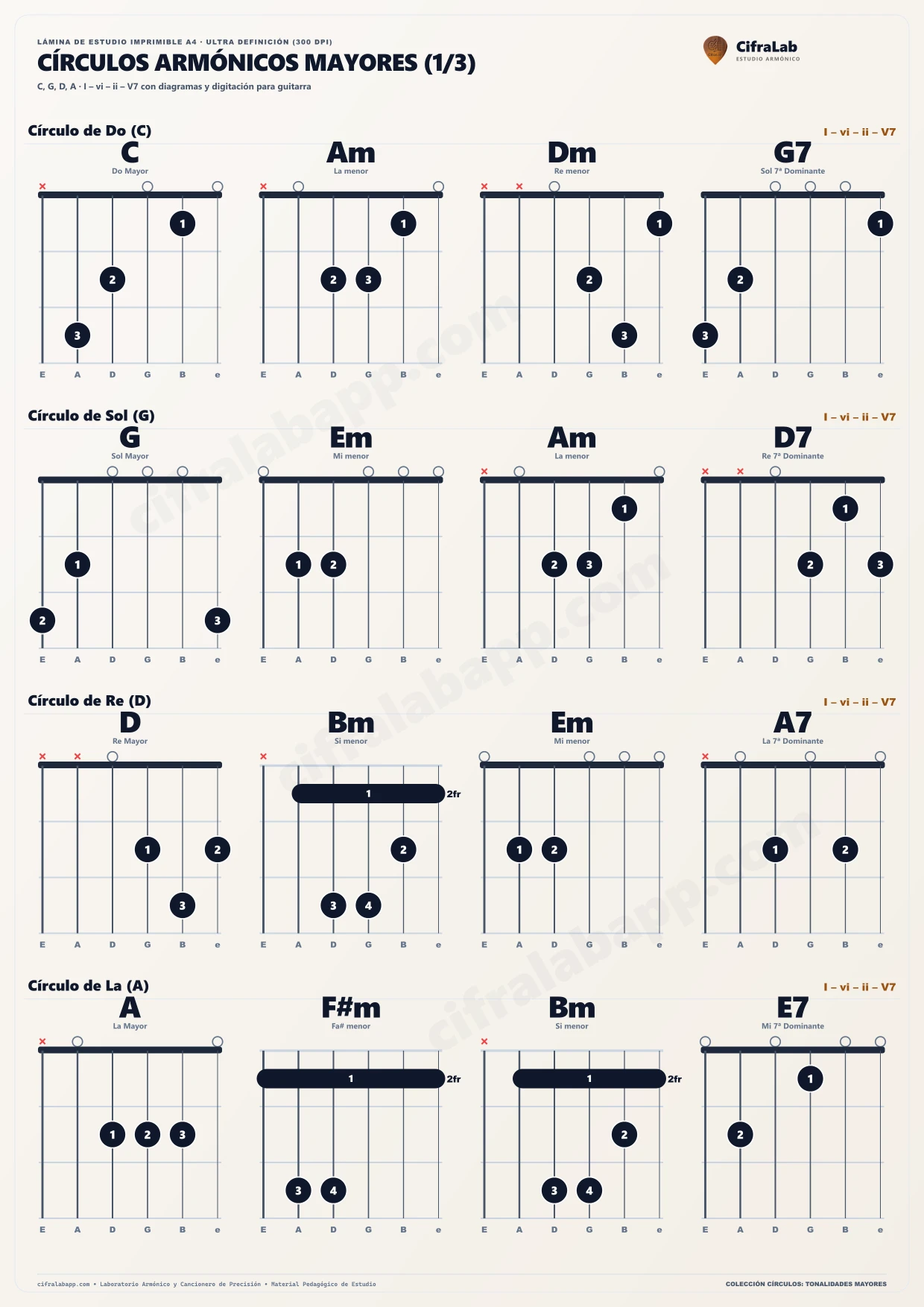
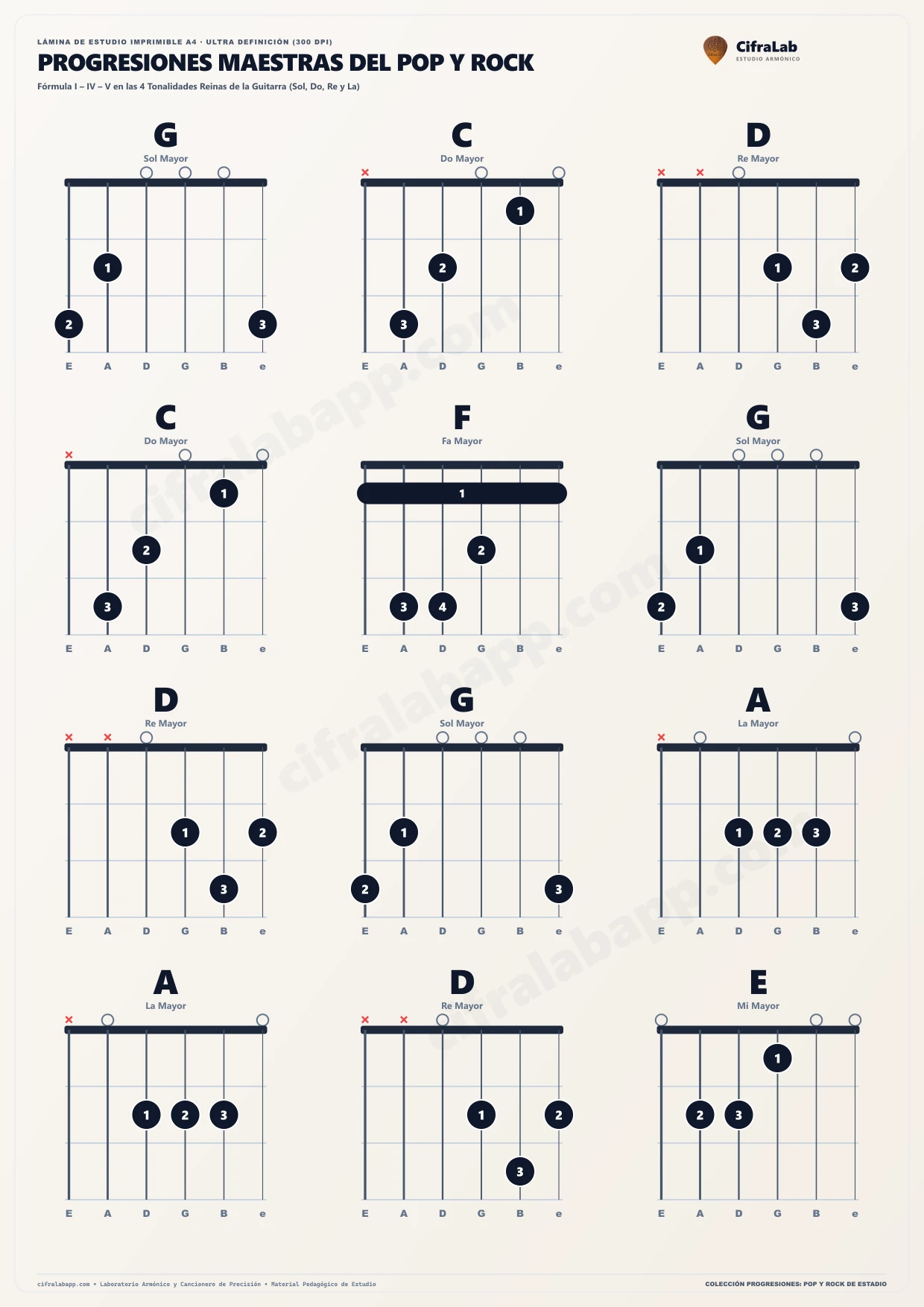
High-resolution A4 sheets with the diagrams of each chord family and of the chord circles. Free to download from each chord page.
Worth reading
- A history of harmony
From Rameau in 1722 to popular music. This is how the progressions we play today were born.
- How chord circles work
The analysis of the 24 progressions in four steps, from the tonic to the return.
- Fingering and posture
Fingers 1 to 4, a relaxed barre and left-hand ergonomics.
- Piano pedagogy
Posture, fingers 1 to 5 and how the two hands share the work.
How we work
Each fingering is checked by playing it. The diagram indicates which finger goes on each fret, which strings sound, and which are muted. If a chord has several positions, we show the most common ones on the neck.
The sound is not synthetic. The guitar, with nylon and steel strings, and the piano are recordings of real instruments. Everything works in the browser, without installing anything or creating an account.
The theory is based on recognized authors such as Fernando Sor, Dionisio Aguado, Jean-Philippe Rameau and Hugo Riemann, and each reading lists its sources.
CifraLab is free. It is supported by discreet advertising and voluntary donations.
Frequently asked questions
Is CifraLab free?
Yes. All content and tools are free and you do not need to create an account.
Do I need to read sheet music?
No. Chords are shown as diagrams. Each dot indicates which string and fret each finger goes on. The readings explain the theory step by step.
Does it work on my phone?
Yes. The site adapts to any screen and the sound plays in your phone browser.
Can I print the chords?
Yes. Every chord page has a button to download the high-resolution chart or print it on A4.