A Guitar Chord

A guitar chord: see the fingering, compare positions, and hear it before you play.

Back to Chord Dictionary
Shape 1/3
Chord shapes:(3 positions)
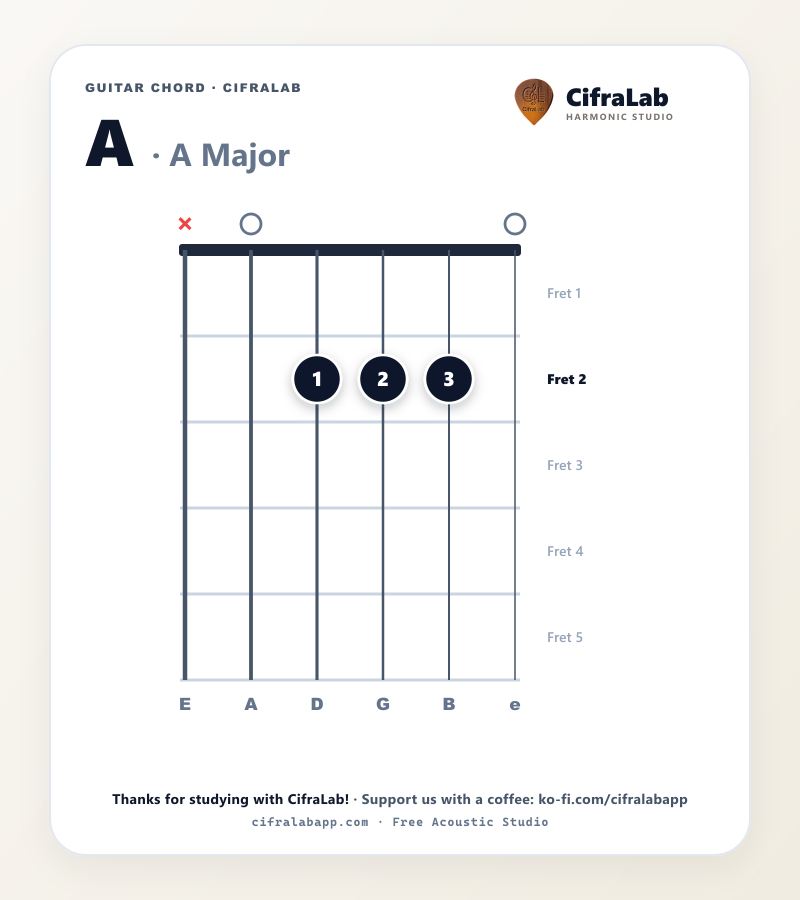
AGuitar fingering diagram for A1234×123STRING6ª×5ªA4ªE3ªA2ªC#1ªE

What sets A apart

Play A one string at a time and you hear A, C# and E. A is the root, C# the major third and E the fifth. Said aloud, its notes are A, C sharp and E.

From the low string to the high one you hear A, E, A, C# and E. A rings twice across the five strings, and it is the root. The lowest note is A on string 5 and the highest is E on string 1.

A lets two strings ring open. String 5 gives A and string 1 gives E. String 6 stays silent. Every finger presses at fret 2. Besides the main one there are two more shapes, at frets 5 and 12.

Am is one change away. String 2 moves from fret 2 to fret 1, bringing in C, the minor third of Am. It shares two notes with F#m, A and C#. The change that keeps the most fingers still is to A7. One stays in place.

A shows up in seven keys. In A major it is the I, in D major the V and in E major the IV. The rest appear in the key list. Further down there are three songs that use it.

Chord Progressions

Harmonic circles featuring the A chord:

Music Theory & Formula

Component notes and harmonic structure (A)

Formula: Major Triad (1 - 3 - 5)
Constituent chord intervals:

A 1C# 3E 5

Root Bass (Fundamental String)5th String (A) • Fret 0 (A)

String Control (Muted & Active)5 / 6 • 1 X Muted

3 Fretboard Positions

Other fretboard positions for A:

01

Standard

Standard Position
5 / 6 stringsRoot: 5th String (A)
String Control (Muted & Active):
6th String (Low E)
×Muted
Do not play
Root
5th String (A)
○Open
ADegree 1
4th String (D)
Fret 2Finger 1
EDegree 5
3rd String (G)
Fret 2Finger 2
ADegree 1
2nd String (B)
Fret 2Finger 3
C#Degree 3
1st String (High E)
○Open
EDegree 5

Placement tip: Press: 4th String (D) at fret 2 with your Index finger, 3rd String (G) at fret 2 with your Middle finger, 2nd String (B) at fret 2 with your Ring finger. Play open: 5th String (A), 1st String (High E). Don't play: 6th String (Low E).

02

Barre 5

Barre fret 5
6 / 6 stringsRoot: 6th String (Low E)
String Control (Muted & Active):
Root
6th String (Low E)
Fret 5Barre
ADegree 1
5th String (A)
Fret 7
EDegree 5
4th String (D)
Fret 7
ADegree 1
3rd String (G)
Fret 6
C#Degree 3
2nd String (B)
Fret 5Barre
EDegree 5
1st String (High E)
Fret 5Barre
ADegree 1

Placement tip: Barre fret 5. Press: 5th String (A) at fret 7, 4th String (D) at fret 7, 3rd String (G) at fret 6.

03

Octave

Barre fret 12
5 / 6 stringsRoot: 5th String (A)
String Control (Muted & Active):
6th String (Low E)
×Muted
Do not play
Root
5th String (A)
Fret 12Barre
ADegree 1
4th String (D)
Fret 14
EDegree 5
3rd String (G)
Fret 14
ADegree 1
2nd String (B)
Fret 14
C#Degree 3
1st String (High E)
Fret 12Barre
EDegree 5

Placement tip: Barre fret 12. Press: 4th String (D) at fret 14, 3rd String (G) at fret 14, 2nd String (B) at fret 14. Don't play: 6th String (Low E).

Biomechanics & Posture

Ergonomic tips to play without tension or fatigue (A)

Standard Position
Key Principle:

Stack fingers 1, 2, and 3 in a neat column inside fret 2, slanting your wrist slightly toward the body.

Thumb Placement: Centered behind fret 2 to support the finger arch.

Most Common Beginner Mistake:

Spilling finger 3 over the 1st string, muting the open high E, or placing finger 1 too far back from the fret wire causing 4th-string rattle.

Immediate Solution: If you have larger fingertips, try using fingers 2-3-4 instead of 1-2-3; this naturally clears additional room next to the nut.

The shape in numbers

ItemIn this chord
Fretsfret 2
Fretting fingers3
Open5th and 1st
Muted6th

What to check

The open 5th and 1st strings sit next to a fretting finger.

What every chord shares is in the fingering reading.

Transitions & Pivot Fingers

Most common chord transitions from A

Listen: A → A7 · Dm · F

  1. A
  2. A7
  3. A
  4. Dm
  5. A
  6. F
A → A701
Pivot / Anchor Finger:1 finger stays
Stay in place
  • finger 1: string 4, fret 2
Move
  • finger 2: string 2, fret 2
A → Dm02
Pivot / Anchor Finger:1 finger stays
Stay in place
  • finger 2: string 3, fret 2
Move
  • finger 3: string 2, fret 3
  • finger 1: string 1, fret 1
A → F03
Pivot / Anchor Finger:1 shared position
Stay in place
  • string 3, fret 2
Move
  • string 6, fret 1
  • string 5, fret 3
  • string 4, fret 3
  • string 2, fret 1
  • string 1, fret 1

A in every key

A sits in the scale of 7 keys.

Main shape at a glance

Difficulty
1/5
Highest fret
2
Frets the hand covers
1
Barre
No
Strings that ring
5/6
Fretting fingers
3

A on other instruments

Songs with this chord

Famous songs featuring this chord (A)

Well-known songs where this chord plays a clear role

01"Wild Thing"The Troggs • 1966Part of the main riff (A - D - E - D).
02"Stand By Me"Ben E. King • 1961Part of the chord loop that repeats through most of the song (A - F#m - D - E).
03"Tears in Heaven"Eric Clapton • 1992The home chord, the tonic of the song (A - E/G# - F#m).
Frequently asked questions

Frequently asked questions about the chord (A)

The questions that come up most when playing this chord

Which strings are played and which are muted in the A chord?

To play the A chord on guitar, only 5 strings are played, from string 5 to string 1. Muted strings must be gently dampened with the fleshy side of a fretting finger to prevent dissonance.

What is the root bass note of the A chord and on which string is it located?

The primary bass note of the A chord is its root note: A. In standard guitar tuning (EADGBe), this bass note is located on string 5 at fret 0.

When strumming or fingerpicking, strike this string first.

What notes make up the A chord and what is its formula?

The A chord is constructed using the 1 - 3 - 5 formula (Major Triad). Its constituent pitches are A, C#, E.

How do you prevent the A chord from buzzing or sounding muted?

To prevent the A chord from buzzing or sounding muted, press the strings using the tips of your fingers at a strict 90-degree hammer angle. Position each finger immediately behind the fret wire with your thumb centered behind the neck.

What famous songs use the A chord?

"Wild Thing" (The Troggs, 1966). Part of the main riff (A - D - E - D).

"Stand By Me" (Ben E. King, 1961).

Part of the chord loop that repeats through most of the song (A - F#m - D - E). "Tears in Heaven" (Eric Clapton, 1992).

The home chord, the tonic of the song (A - E/G# - F#m).

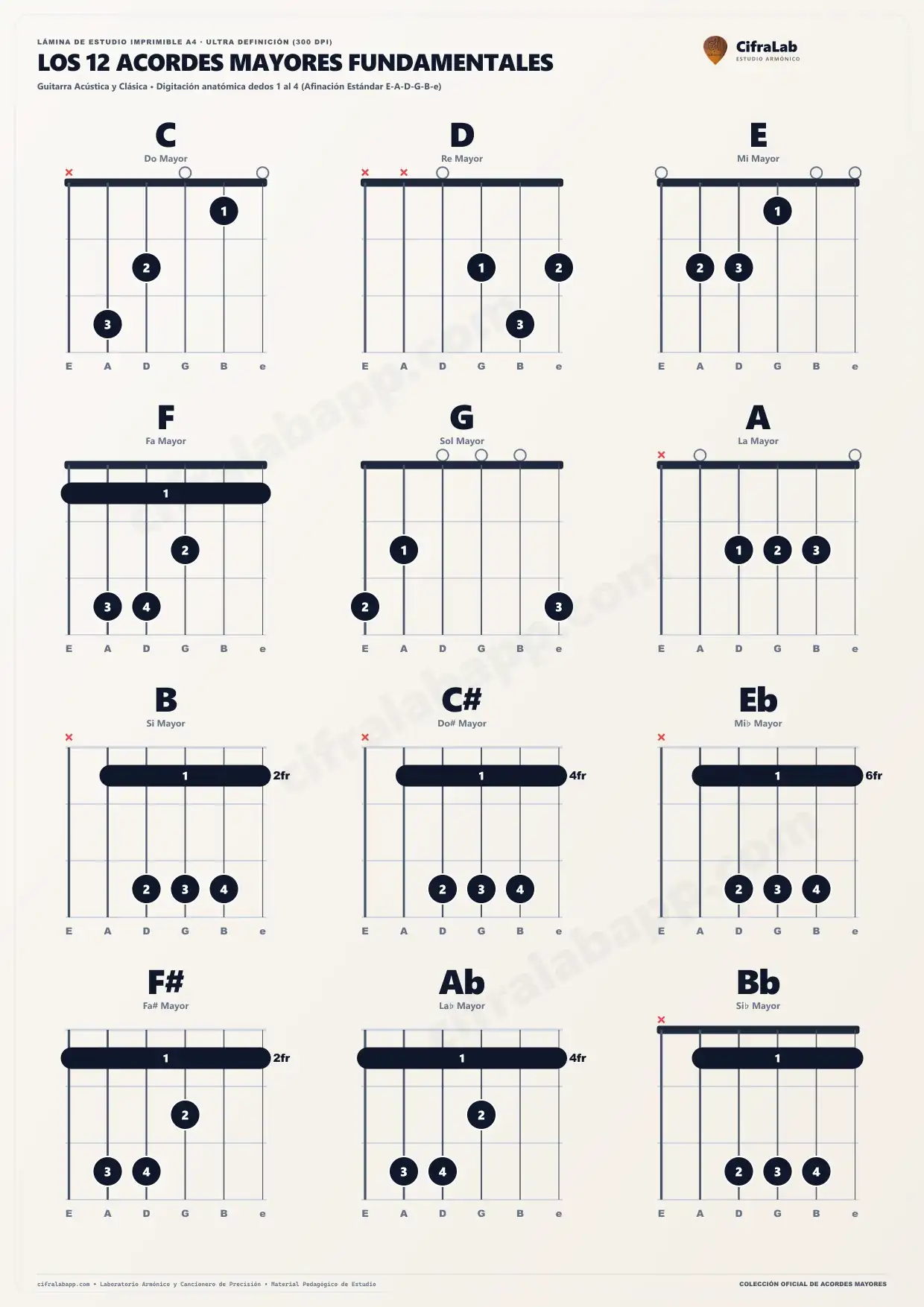
Study sheet · High resolution

Official A chord diagram

A guitar chord diagram with fingering for fingers 1 to 4

Thanks for studying with CifraLab

If this chord helped you, support us with a coffee on Ko-fi.

Buy a coffee