
Harmonic Circles
Harmonic Circle of E Major (E)
I – vi – ii – V7Harmonic progression with an interactive player and guitar diagrams.
Sequence and Tonal Functions of the Circle E
To achieve smooth chord transitions, always identify anchor fingers (common notes held on the fretboard) and keep your wrist relaxed without sudden arm movements. Practice the loop at a slow tempo before speeding up.
How the chords connect in E major
The progression
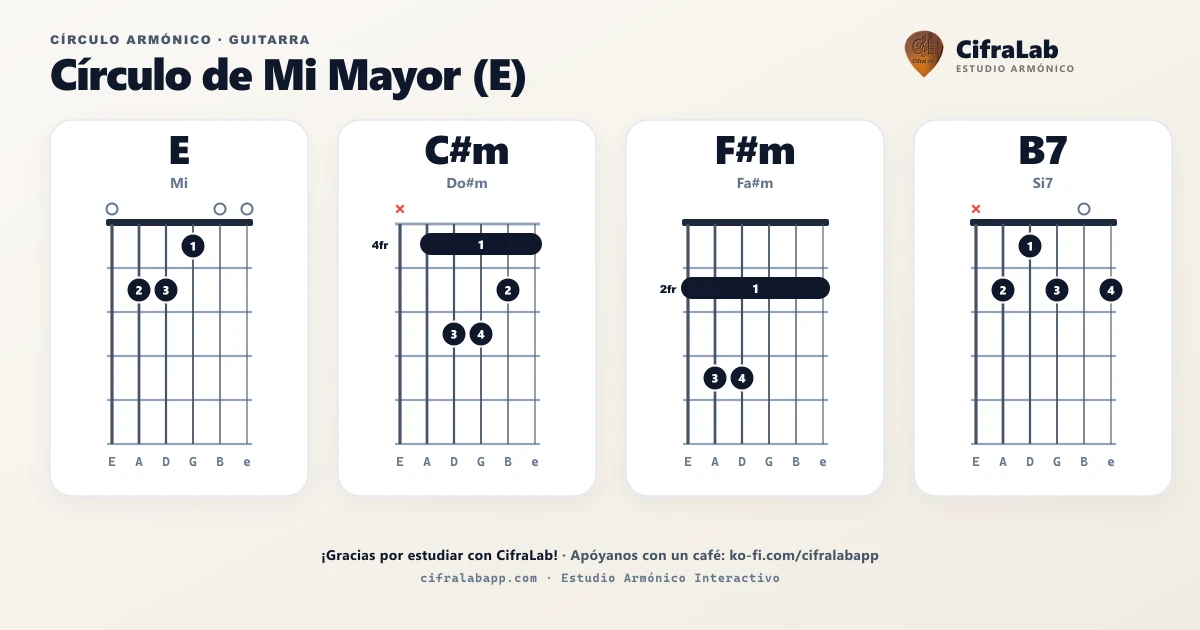
E, C#m, F#m and B7 make up the E major circle, as degrees I, vi, ii and V7.
The notes of each chord
E holds E, G# and B. In C#m you hear C#, E and G#. F#m holds F#, A and C#. In B7 you hear B, D#, F# and A.
From one chord to the next
E and C#m share E and G#, though the hand changes shape. From C#m to F#m, C# stays, and one hand position stays put. F#m and B7 keep F# and A in common. Also, two hand positions stay put.
Back to the start
Going back from B7 to E, D# rises a semitone to E and A falls a semitone to G#. The two chords share B.
The hand
E presses three positions and leaves three strings open. C#m takes a barre at fret 4, leaving string 6 unplayed. F#m needs a barre at fret 2. B7 rings with string 2 open and four fretted positions, leaving string 6 unplayed. The highest fret in the circle is fret 6, in C#m. C#m and F#m use a barre.
E harmonic circle diagram
Thanks for studying with CifraLab
A free and open study tool. If this circle helped you, support the project by buying us a coffee.
Key map: E
- Key signature
- 4 sharps
- Scale notes
- E – F# – G# – A – B – C# – D#
- Relative key
- C#m
- How to play it with a capo
- open shapes, no capoD shapes + capo on fret 2C shapes + capo on fret 4A shapes + capo on fret 7
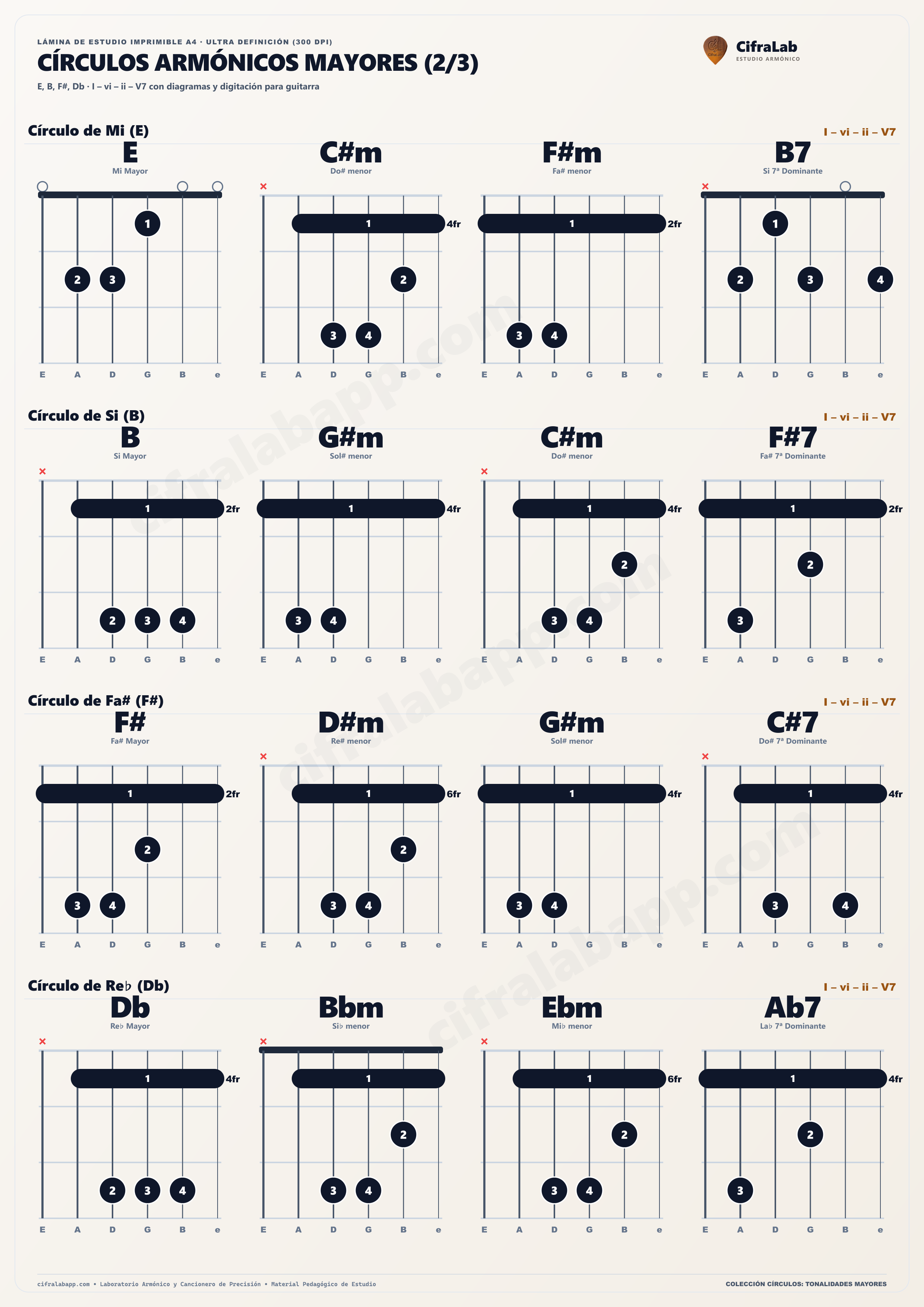 Download the printable A4 sheet (this circle and 3 more)
The E circle for guitar
The thumb plays the 6th string for E and F#m and the 5th string for C#m and B7.
Show tab and notation
Show the piano version (grand staff)
The E circle on the staff
The left hand plays E, C#, F#, and B in the bass.
Loading score…
Show the notes as text, beat by beat
Bar 1 · E
| Count | 1 | 2 | 3 | 4 |
|---|---|---|---|---|
| Right hand (RH) | B4G#4E4 | B4G#4E4 | ||
| Left hand (LH) | E3 | B3 |
Bar 2 · C#m
| Count | 1 | 2 | 3 | 4 |
|---|---|---|---|---|
| Right hand (RH) | G#4E4C#4 | G#4E4C#4 | ||
| Left hand (LH) | C#3 | G#3 |
Bar 3 · F#m
| Count | 1 | 2 | 3 | 4 |
|---|---|---|---|---|
| Right hand (RH) | C#5A4F#4 | C#5A4F#4 | ||
| Left hand (LH) | F#2 | C#3 |
Bar 4 · B7
| Count | 1 | 2 | 3 | 4 |
|---|---|---|---|---|
| Right hand (RH) | A4F#4D#4B3 | A4F#4D#4B3 | ||
| Left hand (LH) | B2 | F#3 |
Famous Songs Using the Circle (E)
Well-known songs that use this progression
"Johnny B. Goode"
E - A - B7Fundamental blues and rock sequence in the tonal center of E Major.
"Brown Eyed Girl"
G - C - G - D (with modulations to E)Folk-pop rhythm of open chords.
Frequently Asked Questions about the Circle (E)
Concrete, direct answers on fingering, strumming, and music theory
Which chords make up the E harmonic circle and what order are they played in?
The E harmonic circle consists of four chords following the I - vi - ii - V7 formula: E - C#m - F#m - B7. In guitar practice, it is played in 4/4 time, typically giving one measure (4 beats) to each chord before transitioning to the next in a seamless loop.
What famous songs use the E harmonic circle?
The E harmonic circle is used in worldwide hit songs such as "Johnny B. Goode" (Chuck Berry), "Brown Eyed Girl" (Van Morrison).
In these works, the E - C#m - F#m - B7 cycle creates a continuous loop of home, movement, tension, and resolution.
What is the harmonic function of each chord in the E circle?
In the E circle, the first chord (E) provides the home tonic (Degree I/i); the second (C#m) introduces relative contrast; the third (F#m) prepares motion; and the fourth (B7) creates dominant seventh tension (V7) resolving smoothly back to the tonic.
What is the best strumming pattern to practice the E harmonic circle?
To build muscle memory and steady rhythm on the E circle, practice with a Pop Ballad or Acoustic Strumming pattern at 75 to 85 BPM. Emphasize the root bass note on beat 1 followed by relaxed down and up strums on beats 2, 3, and 4.
Want to know how each chord feels?
Discover how the brain experiences Home, The Landscape, The Adventure, and The Return