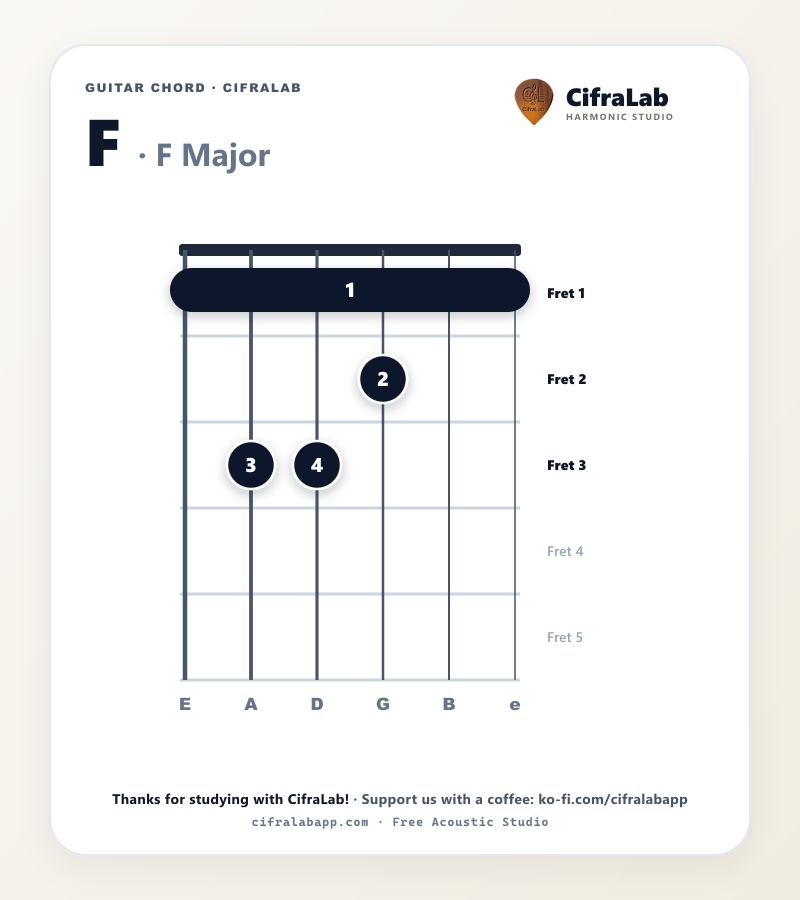
Barre 1
Barre fret 1Placement tip: Barre fret 1. Press: 5th String (A) at fret 3, 4th String (D) at fret 3, 3rd String (G) at fret 2.
F guitar chord: see the fingering, compare positions, and hear it before you play.
P - m - i - m · Alternating Folk (4/4 · 4 notes · Level 1)
The 1st string repeats the F of the 6th. This pattern leaves it out. All 6 arpeggios
Alternating picking with steady pulse.
F is built from F, A and C. F is the root, A the major third and C the fifth.
String by string, low to high, it plays F, C, F, A, C and F. F rings three times across the six strings, and it is the root. The lowest and highest notes are both F, two octaves apart, on strings 6 and 1.
You play F with a barre at fret 1. Your hand covers three frets, from 1 to 3. This page has three positions. The others start at frets 1 and 8.
Change only string 3 in F and you have Fm. F and Dm have F and A in common. F7 shares five positions with this shape.
You will find F in seven different keys. In F major it is the I, in Bb major the V and in C major the IV. The rest appear in the key list. Further down there are three songs that use it.
F 1A 3C 5
Root Bass (Fundamental String)6th String (Low E) • Fret 1 (F)
String Control (Muted & Active)6 / 6 • Active and muted strings status indicator
Placement tip: Barre fret 1. Press: 5th String (A) at fret 3, 4th String (D) at fret 3, 3rd String (G) at fret 2.
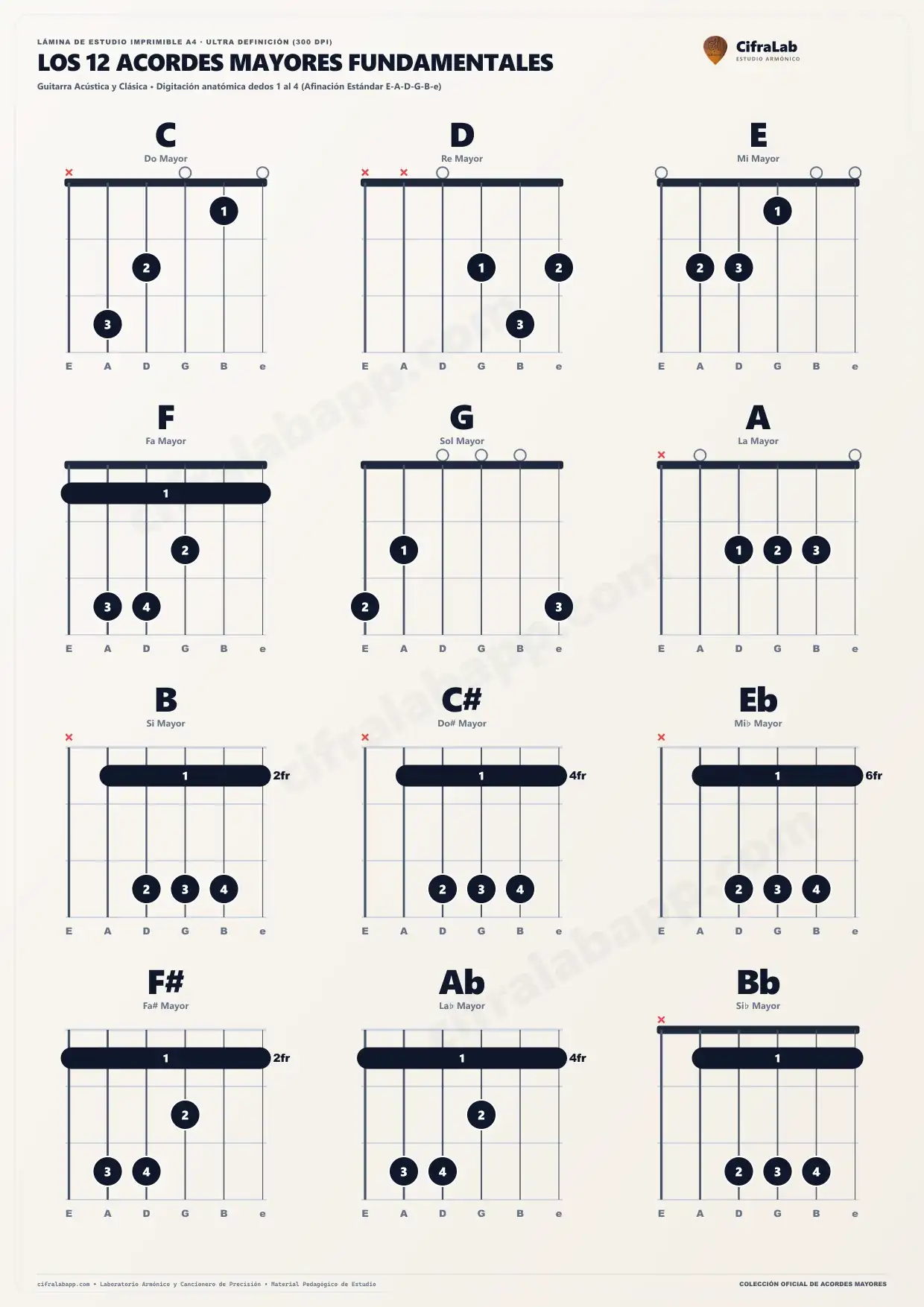
Placement tip: Barre fret 8. Press: 4th String (D) at fret 10, 3rd String (G) at fret 10, 2nd String (B) at fret 10. Don't play: 6th String (Low E).
Placement tip: Press: 4th String (D) at fret 3 with your Ring finger, 3rd String (G) at fret 2 with your Middle finger, 2nd String (B) at fret 1 with your Index finger, 1st String (High E) at fret 1 with your Index finger. Don't play: 6th String (Low E), 5th String (A).
Rotate your index finger slightly onto its outer bony side for a clean, painless barre.
Thumb Placement: Anchored firmly in the center of the neck behind fret 1.
Squeezing like a nutcracker between thumb and index, exhausting the thenar muscle in seconds instead of drawing mechanical force from the arm.
Immediate Solution: Practice the barre chord momentarily without the thumb touching the back of the neck; gently pull your arm backward against the guitar body to discover leverage-based pressure.
| Item | In this chord |
|---|---|
| Frets | 1 to 3 |
| Barre | fret 1, from the 6th to the 1st string |
| Fretting fingers | 4 |
| Open | none |
| Muted | none |
At fret 1, only the barre sounds the 6th, 2nd, and 1st strings.
Listen: F → F7 · C · Am
F sits in the scale of 7 keys.
Well-known songs where this chord plays a clear role
The questions that come up most when playing this chord
To play the F chord on guitar, all 6 strings are played from the 6th string (Low E) to the 1st string (High E). Arch your finger joints perpendicular to the fretboard so adjacent strings ring clearly.
The primary bass note of the F chord is its root note: F. In standard guitar tuning (EADGBe), this bass note is located on string 6 at fret 1.
When strumming or fingerpicking, strike this string first.
The F chord is constructed using the 1 - 3 - 5 formula (Major Triad). Its constituent pitches are F, A, C.
To prevent fret buzz on the F barre chord, roll your index finger slightly outward (about 15 degrees) to press with its harder bony edge. Position your finger directly behind the fret wire and apply gentle arm pull from your back rather than squeezing with thumb force.
"Like a Rolling Stone" (Bob Dylan, 1965). Heard in the verse (C - Dm - Em - F - G).
"Yesterday" (The Beatles, 1965). The home chord, the tonic of the song (F - Em7 - A7 - Dm).
"La Bamba" (Ritchie Valens, 1958). Part of the chord loop that repeats through most of the song (C - F - G).

Thanks for studying with CifraLab
If this chord helped you, support us with a coffee on Ko-fi.