Gmaj9 Guitar Chord

Gmaj9 guitar chord: see the fingering, compare positions, and hear it before you play.

Back to Chord Dictionary
Shape 1/3
Chord shapes:(3 positions)
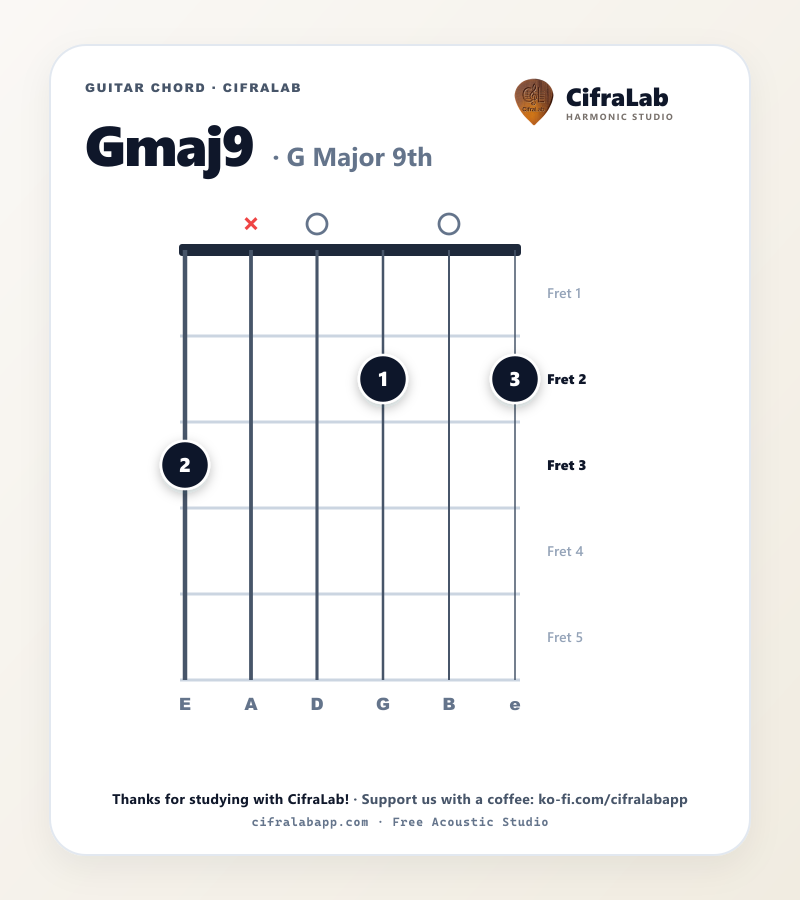
Gmaj9Guitar fingering diagram for Gmaj912342×13STRING6ªG5ª×4ªD3ªA2ªB1ªF#

What sets Gmaj9 apart

Play Gmaj9 one string at a time and you hear G, B, D, F# and A. G is the root, B the major third, D the fifth, F# the major seventh and A the ninth. Said aloud, its notes are G, B, D, F sharp and A.

String by string, low to high, it plays G, D, A, B and F#. It runs from G on string 6 up to F# on string 1.

The open strings add notes to Gmaj9 too. String 4 gives D and string 2 gives B. String 5 stays silent. Your hand covers two frets, from 2 to 3. This page has three positions. The others start at frets 3 and 9.

Gmaj7 is very close. You only move strings 5 and 3. Inside Gmaj9 sits a complete D chord, made of D, F# and A. Moving to G, you keep one finger down.

You will find Gmaj9 in four different keys. In G major it is the Imaj9, in D major the IVmaj9 and in B minor the VImaj9. The rest appear in the key list.

Chord Progressions

Explore recommended harmonic circles on CifraLab:

Music Theory & Formula

Component notes and harmonic structure (Gmaj9)

Formula: Major Seventh with Ninth (1 - 3 - 5 - 7 - 9)
Constituent chord intervals:

G 1B 3D 5F# 7A 9

Root Bass (Fundamental String)6th String (Low E) • Fret 3 (G)

String Control (Muted & Active)5 / 6 • 1 X Muted

3 Fretboard Positions

Other fretboard positions for Gmaj9:

01

Acoustic

Standard Position
5 / 6 stringsRoot: 6th String (Low E)
String Control (Muted & Active):
Root
6th String (Low E)
Fret 3Finger 2
GDegree 1
5th String (A)
×Muted
Do not play
4th String (D)
○Open
DDegree 5
3rd String (G)
Fret 2Finger 1
ADegree 9
2nd String (B)
○Open
BDegree 3
1st String (High E)
Fret 2Finger 3
F#Degree 7

Placement tip: Press: 6th String (Low E) at fret 3 with your Middle finger, 3rd String (G) at fret 2 with your Index finger, 1st String (High E) at fret 2 with your Ring finger. Play open: 4th String (D), 2nd String (B). Don't play: 5th String (A).

02

Drop 2 Jazz

Inversion
4 / 6 stringsRoot: 5th String (A)
String Control (Muted & Active):
6th String (Low E)
×Muted
Do not play
Root
5th String (A)
Fret 10Finger 2
GDegree 1
4th String (D)
Fret 9Finger 1
BDegree 3
3rd String (G)
Fret 11Finger 4
F#Degree 7
2nd String (B)
Fret 10Finger 3
ADegree 9
1st String (High E)
×Muted
Do not play

Placement tip: Press: 5th String (A) at fret 10 with your Middle finger, 4th String (D) at fret 9 with your Index finger, 3rd String (G) at fret 11 with your Pinky finger, 2nd String (B) at fret 10 with your Ring finger. Don't play: 6th String (Low E), 1st String (High E).

03

Barre 3

Barre fret 3
6 / 6 stringsRoot: 6th String (Low E)
String Control (Muted & Active):
Root
6th String (Low E)
Fret 3Barre
GDegree 1
5th String (A)
Fret 5Finger 3
DDegree 5
4th String (D)
Fret 4Finger 2
F#Degree 7
3rd String (G)
Fret 4Finger 2
BDegree 3
2nd String (B)
Fret 3Barre
DDegree 5
1st String (High E)
Fret 5Finger 4
ADegree 9

Placement tip: Barre fret 3. Press: 5th String (A) at fret 5 with your Ring finger, 4th String (D) at fret 4 with your Middle finger, 3rd String (G) at fret 4 with your Middle finger, 1st String (High E) at fret 5 with your Pinky finger.

Biomechanics & Posture

Ergonomic tips to play without tension or fatigue (Gmaj9)

Standard Position

The shape in numbers

ItemIn this chord
Frets2 to 3
Fretting fingers3
Open4th and 2nd
Muted5th

What to check

The open 4th and 2nd strings sit next to a fretting finger.

The 5th string stays muted between strings that ring.

What every chord shares is in the fingering reading.

Transitions & Pivot Fingers

Most common chord transitions from Gmaj9

Listen: Gmaj9 → G · D · D7

  1. Gmaj9
  2. G
  3. Gmaj9
  4. D
  5. Gmaj9
  6. D7
Gmaj9 → G01
Pivot / Anchor Finger:1 finger stays
Stay in place
  • finger 2: string 6, fret 3
Move
  • finger 1: string 5, fret 2
  • finger 3: string 1, fret 3
Gmaj9 → D02
Pivot / Anchor Finger:1 finger stays
Stay in place
  • finger 1: string 3, fret 2
Move
  • finger 3: string 2, fret 3
  • finger 2: string 1, fret 2
Gmaj9 → D703
Pivot / Anchor Finger:1 finger stays
Stay in place
  • finger 3: string 1, fret 2
Move
  • finger 2: string 3, fret 2
  • finger 1: string 2, fret 1

Gmaj9 in every key

Gmaj9 sits in the scale of 4 keys.

Main shape at a glance

Difficulty
1/5
Highest fret
3
Frets the hand covers
2
Barre
No
Strings that ring
5/6
Fretting fingers
3

Gmaj9 on other instruments

Frequently asked questions

Frequently asked questions about the chord (Gmaj9)

The questions that come up most when playing this chord

Which strings are played and which are muted in the Gmaj9 chord?

To play the Gmaj9 chord on guitar, only 5 strings are played, from string 6 to string 1. Muted strings must be gently dampened with the fleshy side of a fretting finger to prevent dissonance.

What is the root bass note of the Gmaj9 chord and on which string is it located?

The primary bass note of the Gmaj9 chord is its root note: G. In standard guitar tuning (EADGBe), this bass note is located on string 6 at fret 3.

When strumming or fingerpicking, strike this string first.

What notes make up the Gmaj9 chord and what is its formula?

The Gmaj9 chord is constructed using the 1 - 3 - 5 - 7 - 9 formula (Major Seventh with Ninth). Its constituent pitches are G, B, D, F#, A.

How do you prevent the Gmaj9 chord from buzzing or sounding muted?

To prevent the Gmaj9 chord from buzzing or sounding muted, press the strings using the tips of your fingers at a strict 90-degree hammer angle. Position each finger immediately behind the fret wire with your thumb centered behind the neck.

Study sheet · High resolution

Official Gmaj9 chord diagram

Gmaj9 guitar chord diagram with fingering for fingers 1 to 4

Thanks for studying with CifraLab

If this chord helped you, support us with a coffee on Ko-fi.

Buy a coffee