
Minor · Am
Chord Am Minor
Am uses 3 keys, from A4 up to E5, 7 semitones apart.
← Back to the chord dictionaryWhat sets Am apart on the piano
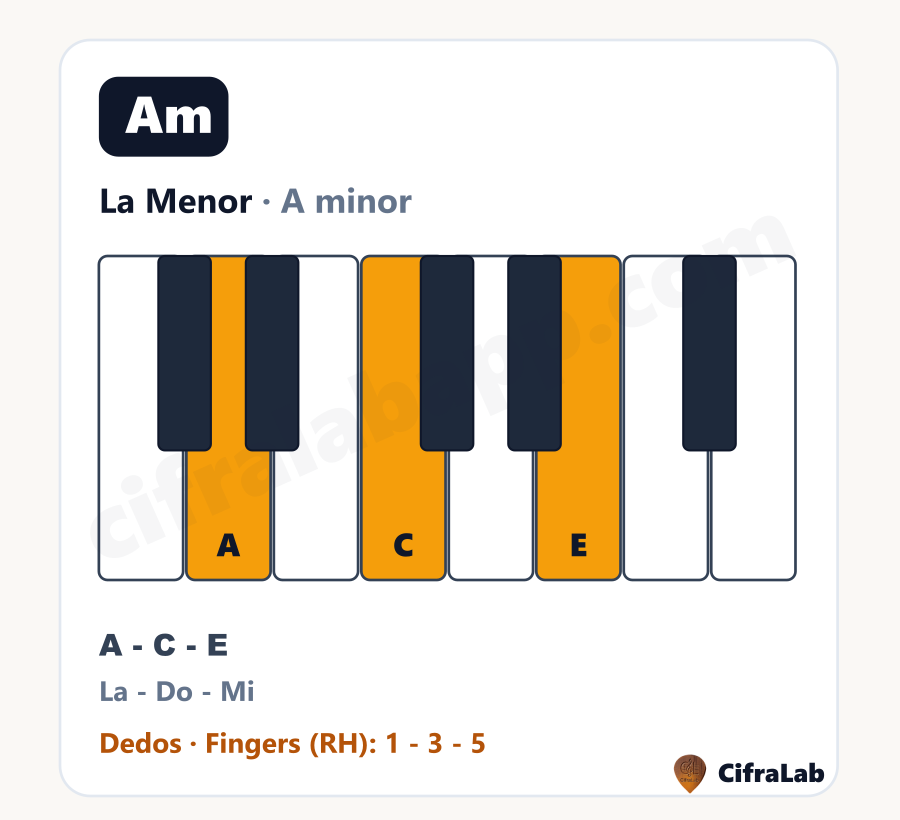
On the piano, the notes of Am are A, C and E. A is the root, C the minor third and E the fifth. All three keys of Am are white.
The gaps in Am are not equal. A to C is three and C to E is four semitones. The frequencies in this position are A4 at 440 Hz, C5 at 523.25 Hz and E5 at 659.25 Hz, with A4 tuned to 440 Hz.
Your right hand plays A with the thumb, C with the middle finger and E with the little finger. From A4 to E5 the hand spans seven semitones.
In the first inversion, A moves up an octave and the lowest note becomes C, the minor third. The fingers are 1 - 2 - 5. The second inversion starts on E, the fifth, and ends on C. The fingers are 1 - 3 - 5.
Move C in Am up a semitone, to C#, and you have A. It shares C and E with C, two of its three notes.
Am shows up in five keys. In C major it is the vi, in G major the ii and in F major the iii.
88-Key Keyboard
Listen to and visualize Am
A Minor (Am)
MinorRoot position
How to play Am Minor
- 1A · finger 1Play A4 with finger 1 of your right hand.
- 2C · finger 3Play C5 with finger 3 of your right hand.
- 3E · finger 5Play E5 with finger 5 of your right hand.
Voicings
Inversions of Am
Across its 3 positions, the lowest note is A, C, and E.
| Position | Notes | Fingering | Lowest note |
|---|---|---|---|
| Root position | A · C · E | 1 - 3 - 5 | A in the bass, the root |
| 1st inversion | C · E · A | 1 - 2 - 5 | C in the bass, the third |
| 2nd inversion | E · A · C | 1 - 3 - 5 | E in the bass, the fifth |
Am in every key
Am sits in the scale of 5 keys.
Major keys
Practice Notebook
Step-by-step guide: Am Minor
- Precise Reading: Notes and Intervals of the A Minor Triad
- Concrete Progression: Related Chords and Harmonic Movement
- Ear Training: Major/Minor Comparison and Identifying the Third
- Visual Orientation: White and Black Keys in A Minor
- Posture and Biomechanics: Tension-Free Hands
- Root Position and Inversions: Bass Line and Hand Movement
- 10 to 15-Minute Practice Routine: Rhythm, Metronome, and Self-Evaluation
- Common Mistakes, Corrections, and Musical Application
Printable sheet for Am Minor
 Open printable sheet →