
Minor · C#m
Chord C#m Minor
C#m uses 3 keys, from C#4 up to G#4, 7 semitones apart.
← Back to the chord dictionaryWhat sets C#m apart on the piano
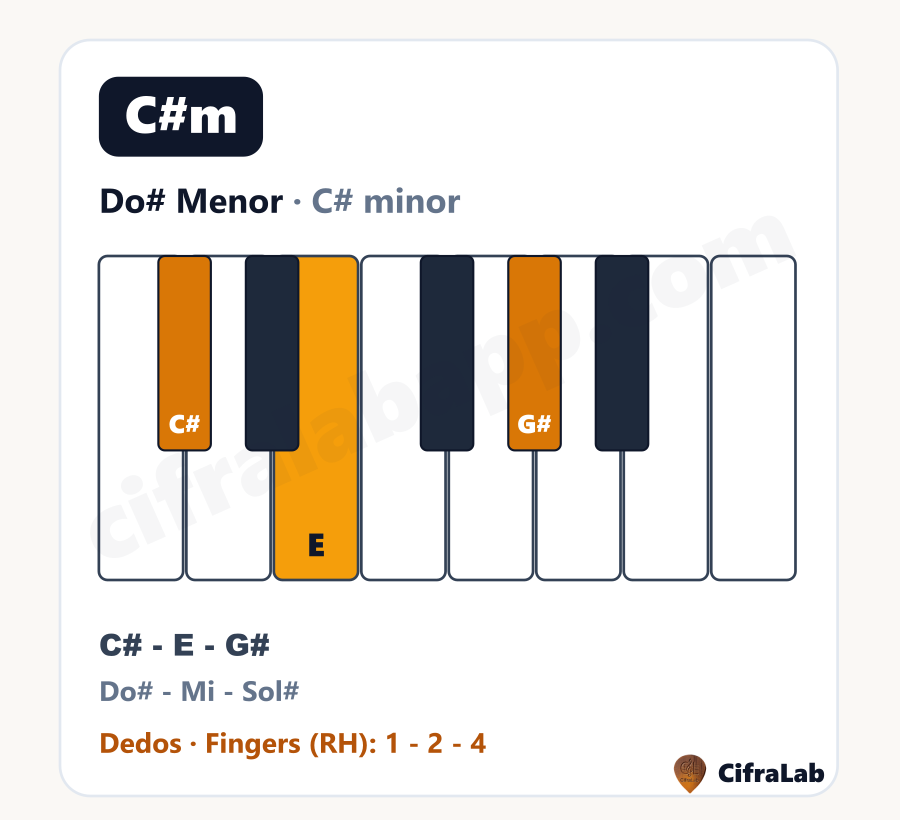
C#m takes three keys, C#, E and G#. C# is the root, E the minor third and G# the fifth. Said aloud, its notes are C sharp, E and G sharp. In C#m, C# and G# sit on black keys and E on a white key.
Counting semitones in C#m, C# to E is three and E to G# is four. With A4 at 440 Hz, this position sounds C#4 at 277.18 Hz, E4 at 329.63 Hz and G#4 at 415.3 Hz.
With the right hand, you build C#m by playing C# with the thumb, E with the index finger and G# with the ring finger. From C#4 to G#4 the hand spans seven semitones.
In the first inversion, C# moves up an octave and the lowest note becomes E, the minor third. The fingers are 1 - 2 - 5. In the second inversion, E moves up an octave and the lowest note becomes G#, the fifth. The fingers are 1 - 3 - 5.
From C#m to C# only one key changes. E moves up a semitone to E#. C#m and E have two notes in common, E and G#.
You will find C#m in five keys. In E major it is the vi, in B major the ii and in A major the iii.
88-Key Keyboard
Listen to and visualize C#m
C# Minor (C#m)
MinorRoot position
How to play C#m Minor
- 1C# · finger 1Play C#4 with finger 1 of your right hand.
- 2E · finger 2Play E4 with finger 2 of your right hand.
- 3G# · finger 4Play G#4 with finger 4 of your right hand.
Voicings
Inversions of C#m
Across its 3 positions, the lowest note is C#, E, and G#.
| Position | Notes | Fingering | Lowest note |
|---|---|---|---|
| Root position | C# · E · G# | 1 - 2 - 4 | C# in the bass, the root |
| 1st inversion | E · G# · C# | 1 - 2 - 5 | E in the bass, the third |
| 2nd inversion | G# · C# · E | 1 - 3 - 5 | G# in the bass, the fifth |
C#m in every key
C#m sits in the scale of 5 keys.
Major keys
Minor keys
Practice Notebook
Step-by-step guide: C#m Minor
- Visual Orientation on White and Black Keys for C# Minor
- Ear Training: Major/Minor Comparison and Third Recognition
- Accurate Reading of the Three Notes and Distances in C# Minor
- Concrete Progression with Related Chords: C#m, A, E, F#m
- Posture and Biomechanics of Both Hands Without Tension for C# Minor
- Root Position and Two Inversions of C# Minor
- 10 to 15 Minute Practice with Rhythm, Metronome, and Self-Assessment
- Common Mistakes, Corrections, and Musical Application of C# Minor
Printable sheet for C#m Minor
 Open printable sheet →